

Date | 2026-04-30 07:42:46
When selecting materials, engineers and procurement teams often face a fundamental question:
What’s the real difference between BMC (Bulk Molding Compound) and common engineering plastics like nylon or polycarbonate?
Why does BMC maintain its shape under high temperatures, while thermoplastics soften?
Why does BMC remain dimensionally stable in humid environments, while some plastics absorb moisture and swell?
The answer lies deep within molecular structure.
This article breaks it down into a simple, intuitive comparison—so you can understand the difference at its root.
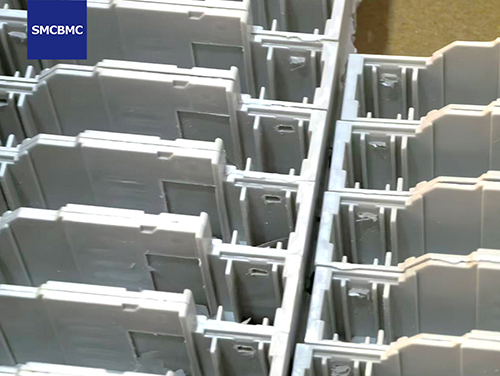
| Property | Thermoplastics (e.g., Nylon, PC) | Thermosets (BMC) |
|---|---|---|
| Molecular structure | Linear or branched chains, free to move | 3D crosslinked network, chemically bonded |
| Behavior under heat | Softens → melts → flows | Does not melt or soften |
| Behavior after cooling | Re-solidifies, can be reshaped | Permanently cured, cannot be reshaped |
| Creep resistance | Prone to deformation over time | Excellent creep resistance |
| Coefficient of thermal expansion | High (60–100 ×10⁻⁶/K) | Low (10–20 ×10⁻⁶/K) |
| Water absorption | 0.5–2% (nylon up to 8%) | ≤0.2% |
| Flame behavior | Depends on additives, may drip | Intrinsically flame-retardant, no dripping |
| Typical applications | Housings, connectors, transparent parts | Electrical insulation, high-temperature structures |
Thermoplastics are like chocolate 🍫
Heat them → they melt
Cool them → they solidify again
BMC (thermoset) is like a cooked egg 🥚
Once cured, it can never return to liquid form
Reheating won’t soften it—it only degrades
Thermoplastics consist of long polymer chains that are not chemically bonded to each other.
Heat → chains slide → material softens
Moisture → water enters between chains → swelling
Stress → chains slowly shift → creep deformation
Think of it as a bowl of loose spaghetti.
During curing, BMC forms strong chemical bonds between polymer chains, creating a three-dimensional network.
Chains are “locked” in place
No movement → no softening
No space → minimal moisture absorption
No sliding → no creep
This is why BMC exhibits its signature properties:
✔ No melting
✔ No dripping
✔ No swelling
✔ No long-term deformation
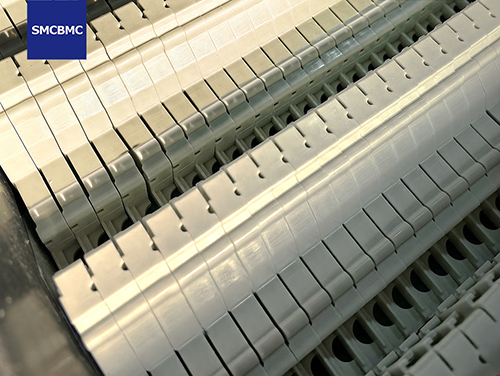
Applications: motor terminal boards, automotive lighting
Thermoplastics: approach softening point → deformation risk
BMC: heat distortion temperature ≥200°C → maintains rigidity
Applications: meter enclosures, cable supports
Thermoplastics: UV degradation, additive migration → aging
BMC: UV-resistant, hydrolysis-resistant → 20–30 year lifespan
Applications: coastal or high-humidity regions
Nylon: absorbs up to 8% water → dimensional instability
BMC: ≤0.2% absorption → stable fit and insulation
Applications: circuit breakers, electrical insulation
Thermoplastics: may melt and drip → secondary fire risk
BMC: no melting, no dripping → forms protective char layer
There is no universal “best” material—only the right one for the application.
Transparency is required
Complex injection-molded geometries are needed
Operating temperatures are low
Cost sensitivity is high
Short lifecycle is acceptable
Long-term dimensional stability is critical
High temperature resistance is required
Moisture and environmental resistance matter
Flame retardancy must be intrinsic
Service life exceeds 10+ years
BMC is not a replacement for all plastics—but in electrical insulation, structural support, and harsh environments, its thermoset nature provides a level of reliability that thermoplastics cannot match.
Understanding materials at the molecular level is the first step toward making better engineering decisions.
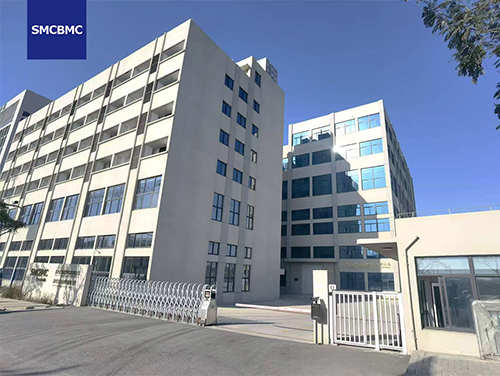
Wenzhou Jintong Complete Appliances Co., Ltd.
Specializing in BMC/SMC thermoset composites and precision molding
Delivering integrated material + component solutions for high-reliability applications
📧 wendy.qiu@smcbmc.com
📞 +8613868305300