
Date | 2026-03-26 07:38:36
In BMC compression molding, the curing process has long been a black box.
Once the mold closes, what is actually happening inside?
When does the material begin to flow?
When does crosslinking start?
When is curing truly complete?
For years, these questions could only be answered through experience and trial runs.
Today, that has changed.
With the introduction of in-mold pressure monitoring equipment, the curing process is no longer invisible. It can now be seen, measured, and analyzed in real time.
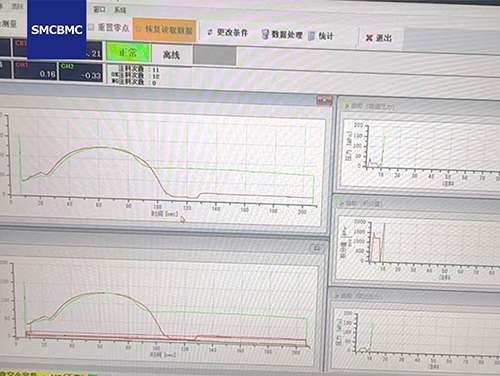
The curing process of BMC inside the mold involves a complex series of physical and chemical changes:
the material softens under heat
it flows to fill the cavity
crosslinking reactions begin
the volume gradually shrinks as curing progresses
All of these changes are reflected in the dynamic pressure curve inside the mold.
By monitoring pressure in real time, we can better understand what is happening during every molding cycle.
The turning points in the pressure curve correspond to key stages such as:
the end of material flow
the beginning of crosslinking
the completion of curing
This gives engineers a much clearer picture of the molding process.
By studying the pressure curve, engineers can adjust:
mold temperature
compression pressure
holding time
This makes it easier to find the most suitable process parameters for each material batch.
Unusual pressure fluctuations may indicate:
incorrect material charge placement
uneven mold temperature
variation between material batches
With real-time data, these issues can be detected and corrected earlier.
Every pressure curve can be recorded and archived, creating an important quality trace for each molding cycle.
This is a major advantage for process validation, quality audits, and root-cause analysis.
In the past, process settings often depended on the experience of skilled operators and repeated trial molding.
Now, with in-mold pressure monitoring, every cycle becomes a visible data curve.
This allows process engineers to:
fine-tune parameters with greater precision
reduce batch-to-batch variation
improve first-pass yield
Most importantly, it helps ensure that the first part and the ten-thousandth part maintain the same performance standard.
For customers in electrical equipment, new energy vehicles, and rail transit, this technology brings practical value:
Every batch undergoes a controlled curing process, significantly reducing performance variation.
Precise curing control helps eliminate risks caused by under-curing or over-curing, improving long-term part stability.
Traceable pressure data provides objective evidence for quality reviews and process analysis.
From material development and mold design to molding process control, we are committed to continuous improvement.
The introduction of in-mold pressure monitoring is another step toward:
process transparency
data-driven control
higher manufacturing reliability
At Wenzhou Jintong Complete Appliances Co., Ltd., we continue to advance our capabilities in BMC/SMC thermosetting composite development and precision molding.
Wenzhou Jintong Complete Appliances Co., Ltd. specializes in the R&D and precision molding of high-performance BMC/SMC thermosetting composites.
📧 wendy.qiu@smcbmc.com
📞 +8613868305300