

Date | 2026-08-17 14:13:42
1. Insert Molding: The Most Common "Combination Process" for Electrical Insulation Parts
Many insulating parts in electrical equipment are not purely plastic — they are composite structures of "plastic + metal inserts": brass inserts in breaker housings, terminals in contactor bases, locating pins in sensors, HV terminals in storage connectors. The inserts carry conduction, connection, fastening or guiding; the material body provides electrical isolation and structural support.
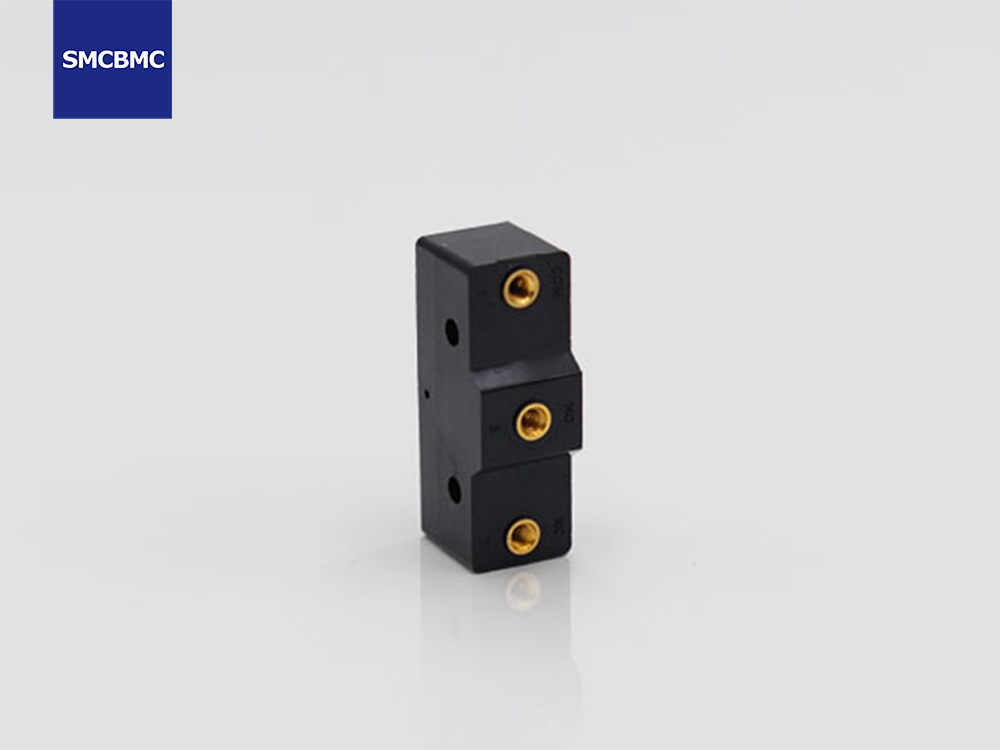
Two ways to join metal inserts with thermosetting materials: post-molding press-fit or adhesive bonding, or pre-embedding before molding with one-shot curing — the latter is insert molding. For BMC/SMC compression molding, insert molding is the mainstream process: the insert is positioned in the cavity; after loading and closing, material flows and cures under pressure and temperature, firmly encapsulating the insert.
Its core value: electrical insulation and mechanical connection completed in a single cycle, no secondary assembly, with significantly better pull-out and torque resistance. But it also creates a "dissimilar material interface" whose quality determines long-term reliability. This article examines how precision fit is achieved — from material properties and process control.
2. Three Key Technical Issues in Insert Molding
2.1 Thermal Expansion Matching: The Physical Foundation of Long-Term Stability
The CLTE difference between metal insert and encapsulating material is the fundamental constraint. Under temperature cycling, unequal deformation stresses the interface: if the metal expands more, the interface is under tension and may crack; if the material shrinks excessively, the insert loosens.
CLTE comparison of common materials (×10⁻⁶/℃):
Material | CLTE (×10⁻⁶/℃) |
Steel | ~12 |
Copper | ~17 |
Aluminum alloy | ~24 |
BMC | 13–35 |
SMC | 12–16 |
PA66 | 80–100 |
PP | 100–200 |
BMC/SMC (13–35) sit in the same order of magnitude as copper (~17) and steel (~12); PA66 (80–100) is 5–6 times copper. Under a 50℃ swing common outdoors, a 100 mm BMC-copper fit differs by about 0.09–0.18 mm; PA66-copper exceeds 0.3 mm. Over long-term cycling, this is why PA66 insert parts loosen or crack, while BMC/SMC parts stay tight.
2.2 Positioning Accuracy: Reliable Insert Fixation in the Mold
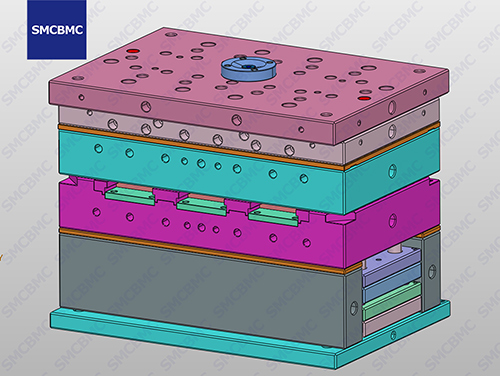
Insert position in the cavity determines final position accuracy. Per Q/JTJ0003-2025, key design points:
• Locating pin / bushing fit: clearance must be controlled — too loose shifts the insert, too tight hampers loading; insert and cavity tolerances are coordinated.
• Position vs. gate: keep inserts out of the direct flow-impact zone so fiber and resin do not displace them.
• Core-pulling: for side demolding, stroke and bottom R corner (≥2 mm) are designed per standard.
Verification: 100 consecutive trial cycles, demolding success ≥99.5%, dimensional stability to GB/T 1804-m — guaranteeing batch consistency.
2.3 Preheating and Interface Bonding: From "Encapsulation" to "Bonding"
Smooth metal surfaces can yield only "encapsulation" — wrapping without bonding — and weak pull-out strength. Common measures:
• Surface treatment: knurling, embossing or sandblasting creates mechanical interlock.
• Preheating: 80–120℃ for larger inserts reduces interfacial thermal stress and improves flow around the insert.
• Grooves / anti-rotation bosses: prevent rotation or axial slip.
Combined with BMC's low shrinkage (17XX series ≤0.2%), the cured material grips the insert firmly — reliable in both mechanical and electrical dimensions.
3. Engineering Control of Process Parameters
Process control balances material flowability against insert stability:
Molding temperature. 135–170℃ per Q/JTJ0002-2025; lower for thin walls (better flow), higher for thick walls (shorter cure); uniformity within ±5℃.
Pressure and closing speed. Three-stage closing (30 → 5 → 15 mm/s); the low-pressure stage closes at 10–20 mm/s to a 5 mm gap, avoiding insert shift; holding at 50–70% of peak for 15–30 s removes micro-voids.
Degassing. At 70–80% fill, multi-stage degassing (release to 0.5 MPa, 2–3 times, ≤0.8 s each) prevents voids at the insert root — a common insulation weak point.
Post-curing. 80–100℃ for 30–60 min releases residual stress and stabilizes the interface.
4. Common Failure Modes and Countermeasures
Failure mode | Cause | Countermeasure |
Insert loosening / rotation | Insufficient shrinkage, smooth insert surface | Knurl/groove insert, low-shrinkage grade, anti-rotation features |
Cracking at insert root | Interfacial thermal stress, uneven ejection | Preheat insert, control mold temperature, optimize ejector position |
Voids / short shots | Poor venting, flow impact | Multi-stage degassing, adjust insert-gate position |
Insert shift / tilt | Weak positioning, closing impact | Strengthen locating fit, reduce closing speed |
Reduced interfacial insulation | Interface gap, micro-cracks | Control shrinkage, post-cure to relieve stress |
5. Wenzhou Jintong's Integrated Capability
Since 2001, Wenzhou Jintong has specialized in BMC/SMC materials, molds and molding; insert molding is a core process for electrical customers. Three levels of capability:
Materials. Low-shrinkage (17XX ≤0.2%), high-temperature (18XX, temperature index ≥170℃) and flame-retardant (16XX, UL94 V-0 at 0.4 mm) series, matched to insert metal and service conditions.
Molds. In-house design and manufacturing per Q/JTJ0003-2025 — cavity precision ±0.02 mm, mirror polishing Ra≤0.1 μm, core hardness ≥HRC58 — supporting insert positioning, core-pulling and multi-cavity designs.
Molding. Per Q/JTJ0002-2025 — mold temperature control ±5℃, three-stage closing, multi-stage degassing, post-curing — batch consistency assured.
For high-reliability insert parts (HV connectors, breakers, contactors, storage connectors), we support customers from insert design and mold development through to volume delivery.
6. Conclusion
Insert-molding reliability is the synergy of material, mold and process. BMC/SMC's metal-like CLTE and controllable low shrinkage provide the material foundation; mold positioning and process control turn it into batch-level reality. Choosing a material is only the start — what keeps a product reliable ten years later is the systematic matching of all three.
Wenzhou Jintong is ready to help you achieve precision fit and long-term reliability — material, mold and molding in one place.
📧 wendy.qiu@smcbmc.com 📞 +86-13868305300