
Date | 2026-02-01 08:24:15
In many engineering discussions, replacing metal with BMC is often described as a simple material switch.
In reality, BMC molding represents a complete manufacturing strategy upgrade, involving structural redesign, process control, and long-term reliability optimization—not merely a change from metal to plastic.
At Wenzhou Jintong Complete Electric Co., Ltd., we work with customers to treat BMC molding as a system-level metal replacement strategy, enabling weight reduction, cost stability, safety enhancement, and design integration across electrical, motor, rail, and energy applications.
Rising metal prices, supply volatility, corrosion issues, and increasing safety standards are forcing manufacturers to rethink traditional metal-based designs.
Metal components often bring:
High weight and inertia
Corrosion and surface treatment costs
Electrical conductivity risks
Multi-part assemblies and complex machining
Cost exposure to raw material price fluctuations
BMC (Bulk Molding Compound) addresses these challenges at the system level—not by imitation, but by redesign.
Unlike metal stamping or machining, BMC molding allows:
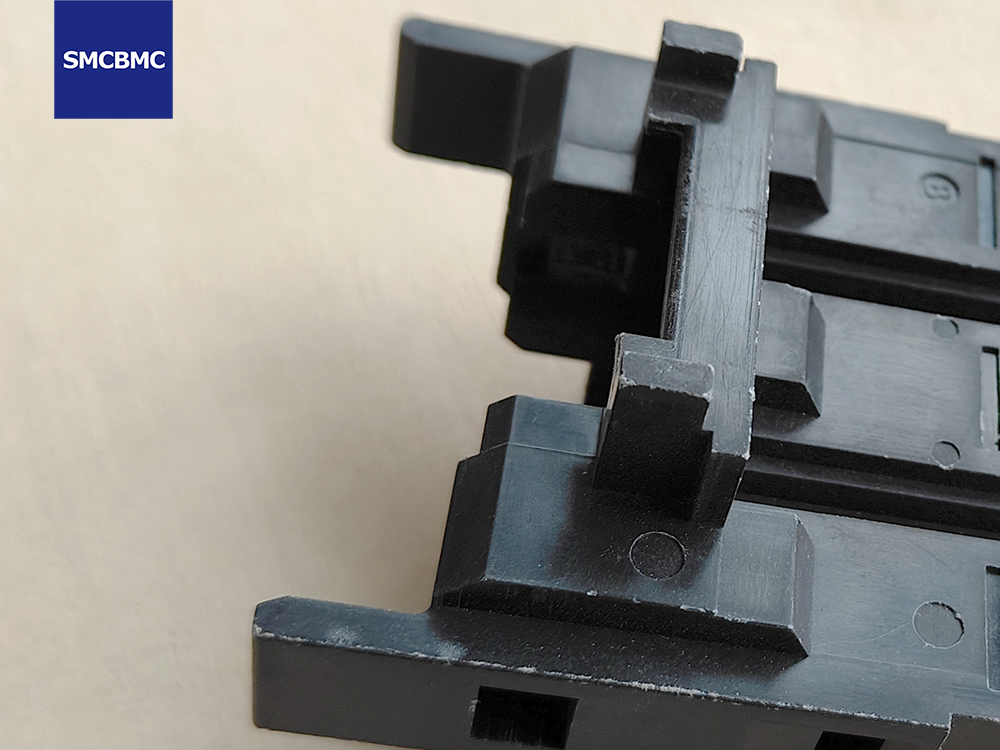
Rib-reinforced structures
Integrated insulation and mechanical support
Embedded metal inserts molded in one step
Elimination of fasteners, welding, and secondary insulation parts
This turns multiple metal components into a single functional composite part, improving consistency and reliability.
BMC is inherently:
Electrically insulating
Arc-resistant
Flame-retardant (UL94 V-0 achievable, even at thin walls)
High CTI (≥600V possible)
For applications such as:
MCB housings
Motor terminal boards
Busbar supports
Transformer insulation blocks
BMC does not require insulation—it is the insulation.
Typical benefits include:
30–60% weight reduction compared to steel or aluminum
High flexural strength (120–200 MPa achievable)
Excellent vibration damping performance
Stable mechanical properties across wide temperature ranges
This is especially critical for:
Electric motors
Rail transit components
Energy infrastructure exposed to vibration and fatigue
Unlike metals tied to global commodity markets, BMC molding offers:
Stable formulation-based cost structure
High repeatability through controlled mold temperature and pressure curves
Low scrap rate in mature processes
Predictable long-term supply
For procurement teams, this means risk reduction, not just cost savings.
Replacing metal with BMC is not plug-and-play.
Successful projects require:
Material formulation matched to load, temperature, and electrical stress
Mold design based on BMC flow behavior and shrinkage control
Precise molding process windows (temperature, pressure, cure time)
At Wenzhou Jintong, we integrate:
BMC material development
Precision mold design
Mass-production molding control
into a single closed-loop system—ensuring that the performance designed on paper is achieved in real production.
Motor terminal boards and end caps
Electrical insulation supports and spacers
Rail transit structural and insulation components
Power distribution housings and enclosures
Energy equipment structural-insulating parts
In these applications, BMC does not replace metal piece by piece—
it replaces the logic of metal-based design.
BMC molding is most powerful when viewed as:
A design strategy
A process-controlled manufacturing system
A long-term reliability solution
Not just as an alternative material.
Wenzhou Jintong Complete Electric Co., Ltd. specializes in:
High-performance BMC/SMC thermosetting composite materials
Precision mold design and manufacturing
Mass-production compression molding for critical structural and insulation components
We support customers in electrical, motor, rail transit,new energy, and industrial equipment industries with integrated material–mold–process solutions.