
Date | 2026-05-11 09:52:27
In railway material selection, “flame retardancy” is often the first requirement engineers mention. But in modern rail transportation, the real safety challenge is no longer simply whether a material ignites — it is how much smoke and toxic gas the material produces during a fire.
For passengers trapped inside a rail carriage, visibility and breathable air determine evacuation time and survival probability. This is precisely why European railway fire safety standard EN 45545-2 places strong emphasis on smoke density (R22) and toxicity index (R23) for non-metallic interior materials.
As global rail manufacturers increasingly align with European standards, EN 45545-2 has become one of the most important benchmarks for BMC and SMC components used in:
electrical insulation systems,
equipment housings,
support structures,
cable management parts,
and interior railway applications.
For engineers evaluating thermoset composites for rail vehicles, understanding R22 and R23 performance is now essential.
EN 45545-2 is the European standard governing fire behavior requirements for materials and components used in railway vehicles.
The regulation classifies railway fire risks into 26 requirement sets (R1–R26), depending on:
component function,
installation location,
accessibility,
and fire exposure conditions.
Among these, R22 (Smoke Density) and R23 (Toxicity of Smoke Gases) are particularly critical for BMC electrical insulation components installed inside passenger areas.
In practical terms:
low smoke density improves evacuation visibility,
while low toxicity reduces the risk of incapacitation during fire events.
This makes R22 and R23 especially important for:
insulators,
terminal blocks,
electrical supports,
switchgear components,
and other railway electrical system parts.
Under EN 45545-2:2020 Appendix C, smoke density testing follows the ISO 5659-2 method.
The material is exposed to a 25 kW/m² radiant heat flux, with both flaming and non-flaming conditions evaluated. The key result is the Ds max (maximum specific optical density) value.
Typical hazard level requirements are:
| Hazard Level | Smoke Density Requirement |
|---|---|
| HL2 | Ds max ≤ 300 |
| HL3 | Ds max ≤ 150 |
The lower the Ds max value, the lower the smoke generation during combustion.
For enclosed railway environments such as passenger cabins, achieving low smoke density is often more important than simply achieving high oxygen index values.
Toxicity testing under EN 45545-2 is typically performed according to:
EN 17084
or NF X 70-100.
The test measures toxic gas emissions including:
CO,
HCN,
HCl,
SO₂,
and other combustion byproducts.
These concentrations are weighted into a final CIT (Conventional Toxicity Index) value.
Typical requirements are:
| Hazard Level | CIT Requirement |
|---|---|
| HL2 | CIT ≤ 0.9 |
| HL3 | CIT ≤ 0.75 |
Low toxicity is increasingly important in modern rail vehicle design because smoke inhalation remains one of the leading causes of fatalities during enclosed-space fires.
Many materials that previously passed:
GB 8624 B1,
or the older BS 6853 standard,
may still struggle under EN 45545-2 smoke and toxicity requirements.
This is especially true for traditional brominated flame-retardant systems.
While brominated additives can improve flame resistance and oxygen index values, they may also generate:
corrosive smoke,
halogen gases,
and higher toxicity levels during combustion.
As a result, a material with excellent LOI performance may still fail R22 or R23 testing.
For railway engineers, this changes the material selection strategy entirely.
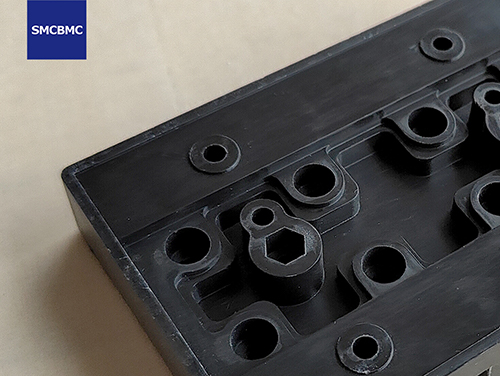
To address modern railway safety requirements, Wenzhou Jintong has developed specialized halogen-free flame-retardant BMC formulations optimized for EN 45545-2 compliance.
According to internal testing data using:
ISO 5659-2,
and EN 17084 methods,
with 3 mm sample thickness, our railway-grade BMC materials demonstrated the following typical performance ranges:
Typical results:
120–180
with some batches below 150
This allows coverage of both:
HL2 requirements,
and selected HL3 applications.
Typical results:
0.4–0.7
These values provide strong compliance margins for:
HL2,
and HL3 railway safety requirements.
The performance of railway-grade BMC materials depends heavily on:
resin chemistry,
flame-retardant systems,
filler interactions,
and smoke suppression technology.
Wenzhou Jintong’s formulations utilize:
aluminum hydroxide,
magnesium hydroxide,
and low-styrene emission control technologies.
During fire exposure:
inorganic flame retardants release water vapor,
absorb heat energy,
dilute combustible gases,
and reduce smoke generation.
At the same time, optimized filler-resin interfaces reduce organic decomposition participation during pyrolysis, helping minimize toxic gas formation at the source.
For engineers selecting BMC materials for:
metro systems,
high-speed rail,
locomotives,
or rolling stock electrical systems,
the following considerations are essential:
A high LOI value does not guarantee low smoke or low toxicity performance.
A material with LOI ≥35 may still fail EN 45545-2 R22/R23 requirements.
A proper EN 45545-2 qualification should include:
separate R22 smoke density data,
and R23 toxicity test results,
not simply a generic “HL2 compliant” statement.
Smoke density performance can vary with wall thickness.
Engineers should request test data matching the actual product thickness (typically 2–3 mm).
Laboratory qualification samples and mass-production batches may differ.
Reliable suppliers should provide:
typical value ranges,
process consistency data,
and quality control capability.
Wenzhou Jintong has established dedicated BMC formulation systems for railway transportation applications, supporting:
EN 45545-2 R22 & R23 requirements,
low-smoke halogen-free solutions,
electrical insulation systems,
and customized hazard-level compliance strategies.
We provide integrated support covering:
material formulation,
mold development,
precision compression molding,
and railway component manufacturing.
As rail systems become faster, denser, and more safety-critical, material performance during fire events is no longer optional engineering optimization — it is a fundamental safety requirement.
And increasingly, low-smoke thermoset composites are becoming a key part of that solution.
Specialized in BMC/SMC thermoset composites for:
Railway transportation
Electrical insulation systems
High-temperature industrial applications
Energy storage & EV systems
📧 wendy.qiu@smcbmc.com
📞 +86 13868305300