

Date | 2026-05-19 07:44:28
One of the most common questions our sales and engineering teams receive is:
“What’s the real difference between BMC and SMC?”
At first glance, both materials belong to the same family of fiber-reinforced thermosetting polyester composites. Both are pre-compounded molding materials widely used in electrical, automotive, railway, and industrial applications.
However, choosing the wrong material can lead to:
Poor mold filling
Dimensional instability
Reduced mechanical performance
Fiber distribution defects
Increased tooling wear and processing costs
This article explains the key differences between BMC (Bulk Molding Compound) and SMC (Sheet Molding Compound) from four engineering perspectives:
Formulation and fiber structure
Molding process compatibility
Performance characteristics
Typical application scenarios
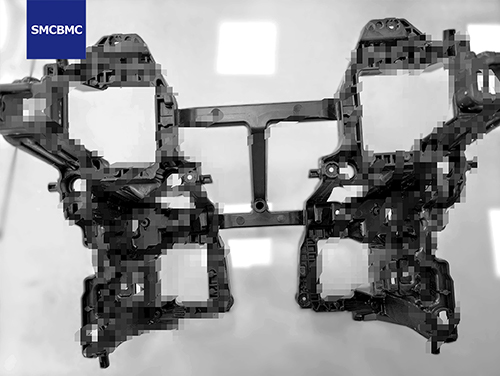
Although BMC and SMC can use similar resin systems — typically unsaturated polyester or vinyl ester resins — the major difference lies in the glass fiber structure.
That difference fundamentally determines:
Flow behavior
Mechanical strength
Surface quality
Processing capability
BMC typically contains:
Chopped glass fibers (3–25 mm)
Resin paste
Mineral fillers
Initiators
Release agents
Flame retardants and additives
The mixture is intensively blended into a bulk-like compound.
Because the fibers are randomly distributed:
Isotropic properties are better
Mold flow is excellent
Complex geometries can be filled more easily
However, the reinforcement efficiency of short fibers is lower compared to long-fiber systems.
SMC uses:
Longer chopped fibers (typically 25–50 mm)
Continuous sheet impregnation process
Resin paste sandwiched between fiber layers
During molding:
Fibers retain more effective length
Fiber orientation becomes more directional
Mechanical performance improves significantly
Compared with BMC, SMC generally provides:
Higher flexural strength
Better impact resistance
Higher tensile strength
According to Jintong internal technical standards (Q/JTJ0001-2025):
| Property | BMC 1625 | BMC 1615 | SMC-1 | SMC-3 |
|---|---|---|---|---|
| Flexural Strength | ≥140 MPa | ≥90 MPa | ≥170 MPa | ≥140 MPa |
| Impact Strength | ≥40 kJ/m² | ≥25 kJ/m² | ≥90 kJ/m² | ≥45 kJ/m² |
| Tensile Strength | ≥35 MPa | ≥20 MPa | ≥100 MPa | ≥55 MPa |
| Flexural Modulus | ≥10000 MPa | ≥8000 MPa | ≥10500 MPa | ≥9500 MPa |
The conclusion is clear:
SMC delivers superior structural strength, while BMC excels in molding flexibility and complex geometry capability.
Both BMC and SMC are commonly processed through compression molding, but BMC also supports:
Injection molding
Transfer molding
SMC, by contrast, is almost exclusively compression molded.
The reason again comes down to fiber length.
The shorter fibers in BMC provide:
Better flowability
Easier cavity filling
Improved thin-wall molding capability
At Jintong, our BMC 16XX series can mold:
Wall thicknesses as low as 0.4 mm
Multi-rib structures
Metal insert components
UL94 V-0 flame-retardant parts
These are geometries that are often difficult for SMC.
SMC performs best in:
Large-area parts
Flat or semi-flat structures
Uniform wall thickness applications
Typical advantages:
Higher rigidity
Better impact resistance
Improved load-bearing performance
However, in parts with:
Deep ribs
Sharp corners
Complex cross-sections
Thin-wall intersections
fiber distribution may become uneven, affecting local strength consistency.
Choose BMC for thin-wall, complex, precision components.
Choose SMC for large, high-strength structural parts.
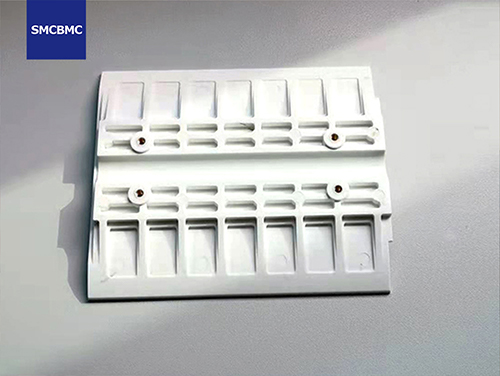
Both materials offer excellent insulation:
Dielectric strength ≥20 kV/mm
Arc resistance ≥180 s
However:
High-filler BMC formulations often retain insulation resistance better under humid conditions
According to Jintong testing:
BMC insulation resistance after 24 h water immersion remains ≥1.0×10¹² Ω
BMC advantages:
Shrinkage can be as low as ≤0.15%
Excellent precision molding capability
SMC also has low shrinkage, but:
Large panels may warp due to fiber orientation differences
Both BMC and SMC can achieve:
UL94 V-0
960°C glow wire resistance
BMC offers more flexibility in flame-retardant formulation because filler loading can be adjusted more easily.
Both materials can achieve:
Thermal index up to 155°C
High-temperature BMC grades (such as BMC 18XX series) can exceed:
Continuous service temperatures above 170°C
MCB housings
Contactor insulation barriers
Smart meter housings
EV PTC heater supports
Chemical pump insulation components
High-voltage switch insulation rods
Thin-wall molding capability
Precision dimensions
Excellent flame retardancy
Strong insulation reliability
Switchgear insulation panels
Arc chambers
Energy storage battery covers
Railway insulation platforms
Automotive body panels
Large-area structural strength
Superior impact performance
Better rigidity
Excellent surface finish
| Requirement | Recommended Material | Main Reason |
|---|---|---|
| Thin-wall complex geometry | BMC | Excellent flowability |
| Large structural component | SMC | Higher mechanical strength |
| Injection molding production | BMC | SMC unsuitable for injection molding |
| High humidity insulation reliability | BMC | Better wet insulation retention |
| High impact load | SMC | Long-fiber reinforcement |
| Precision dimensional tolerance | BMC | Very low shrinkage |
BMC and SMC are not competing materials — they are complementary engineering solutions.
The key is matching:
Geometry
Manufacturing process
Mechanical requirements
Electrical performance
Cost targets
At Jintong, we manufacture both BMC and SMC material systems and support customers with:
Material selection
Mold design optimization
Process engineering
Mass production support
Choosing the right thermoset composite early in product development can significantly improve:
Reliability
Production efficiency
Lifecycle cost performance
For technical support or material selection consultation:
📧 wendy.qiu@smcbmc.com
📞 +86 13868305300