

Date | 2026-09-07 15:59:11
1. Why a Busbar System Needs Insulation Supports
A busbar is a conductive copper or aluminum bar carrying the main current in power distribution systems, widely used in low-voltage switchgear, distribution cabinets, busway, reactive power compensation units and battery storage connections. The busbar itself is a conductor — but between phases, phase-to-ground, and conductor-to-enclosure, reliable insulation support and fixation are essential. These are the busbar clamps, busbar brackets and standoff insulators (insulators).
Busbars present two main engineering challenges: first, at short circuit the instantaneous electrodynamic force can reach thousands of newtons, so the support must absorb the shock without shifting or cracking; second, when a switch opens, arcing and localized high temperature occur, so the support must resist arcing, be flame retardant and withstand heat.
Insulation supports for busbars must therefore combine high electric strength, high insulation resistance, arc resistance and flame retardancy, together with sufficient mechanical strength and dimensional stability.
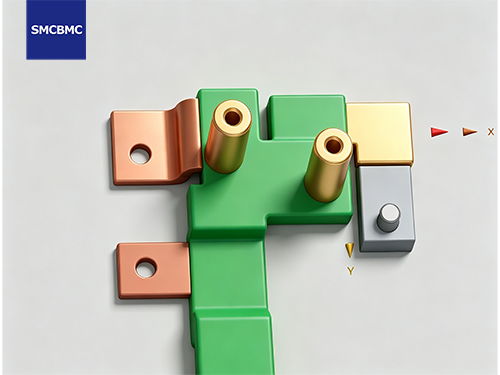
2. BMC: An Ideal Material for Busbar Insulation Support
BMC (bulk molding compound) is a thermoset composite that meets insulation, flame retardancy and mechanical support in a single molding — well suited to busbar supports that must both insulate and carry load. Per the company enterprise standard Q/JTJ0001-2025 and the basic domestic standard GB/T 23641-2018, key BMC properties are:
Property | Requirement | Application note |
Electric strength | ≥20 kV/mm | Base for voltage-withstand (GB/T 1408.1, in oil) |
Insulation resistance (normal) | ≥1.0×10¹³ Ω | Phase-to-phase, phase-to-ground base (GB/T 10064) |
PTI (tracking index) | ≥600 V | Surface tracking resistance (GB/T 4207) |
Arc resistance | ≥180 s | Withstand of switching arcing (GB/T 1411) |
Flammability | UL94 V-0 (0.4 mm) | 16XX series; glow-wire 960 ℃ |
Temperature index | 16XX≥155 ℃, 18XX≥170 ℃ | Long-term heat capability (GB/T 11026.1) |
(Table data per Q/JTJ0001-2025 and GB/T 23641-2018.)
On the mechanical side, BMC 1625 offers flexural strength ≥140 MPa and impact strength ≥40 kJ/m² (per Q/JTJ0001-2025), giving stable clamping load; the 17XX series offers low shrinkage ≤0.2%, suited to busbar brackets that require tight dimensional accuracy. Thermoset materials do not melt and resist creep, maintaining shape and clamping force under long-term current heating.
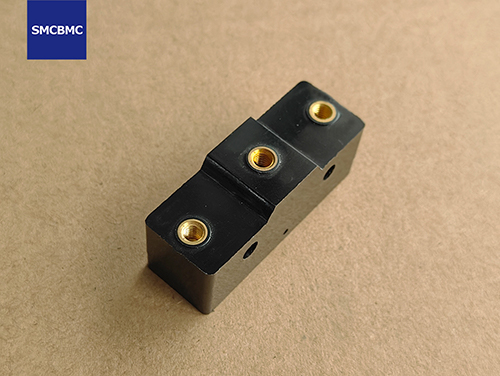
3. Typical Applications and Selection Guidance
• Busbar clamps / brackets: fix the busbar and absorb short-circuit electrodynamic force — focus on mechanical strength and dimensional stability;
• Standoff insulators: phase-to-phase and phase-to-ground insulation support — at higher voltages focus on electric strength and PTI;
• Busway and switchgear: phase-to-phase barriers and connecting-bar insulation parts, balancing flame retardancy and arc resistance;
• Battery storage busbar connections: high-current service — focus on heat resistance, flame retardancy and long-term life (the 18XX high-temperature series can be combined).
Selection tips: verify performance against system voltage and short-circuit electrodynamic force; for higher voltage, prioritize electric strength and PTI; for high-current or high-temperature service, prioritize temperature index and flame retardancy; where fixation accuracy matters, consider the 17XX low-shrinkage series.
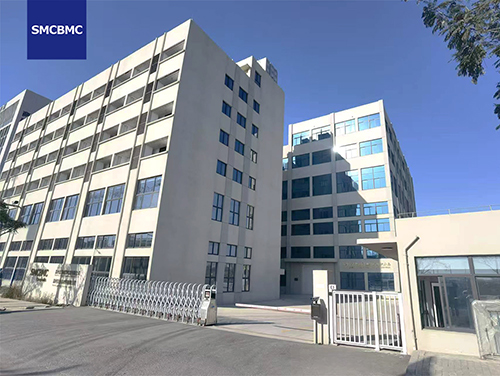
4. Integrated Company Capability
Established in 2001, Wenzhou Jintong specializes in BMC/SMC thermoset materials, molds and molding, with integrated material–mold–molding–testing capability. We can customize formulation and molding to the voltage class, current-carrying capacity and mounting structure of a busbar system, serving low-voltage electrical and distribution customers.
📧 wendy.qiu@smcbmc.com 📞 +86-13868305300