

Date | 2026-07-17 09:37:14
A national standard is a floor, not a ceiling. And for electrical insulation materials that must perform reliably over decades, the floor is rarely high enough.
GB/T 23641-2018 — China's national standard for fiber-reinforced unsaturated polyester molding compounds (SMC/BMC) — defines the minimum acceptable properties every supplier must meet. It's designed by committee for broad industry consensus, which means the bar is set where the majority of manufacturers can clear it without excessive cost. For a commodity application, that threshold may suffice. For a 1500 V DC battery storage insulator, a 25-year outdoor PV inverter, or a railway component certified to EN 45545-2, it is not.
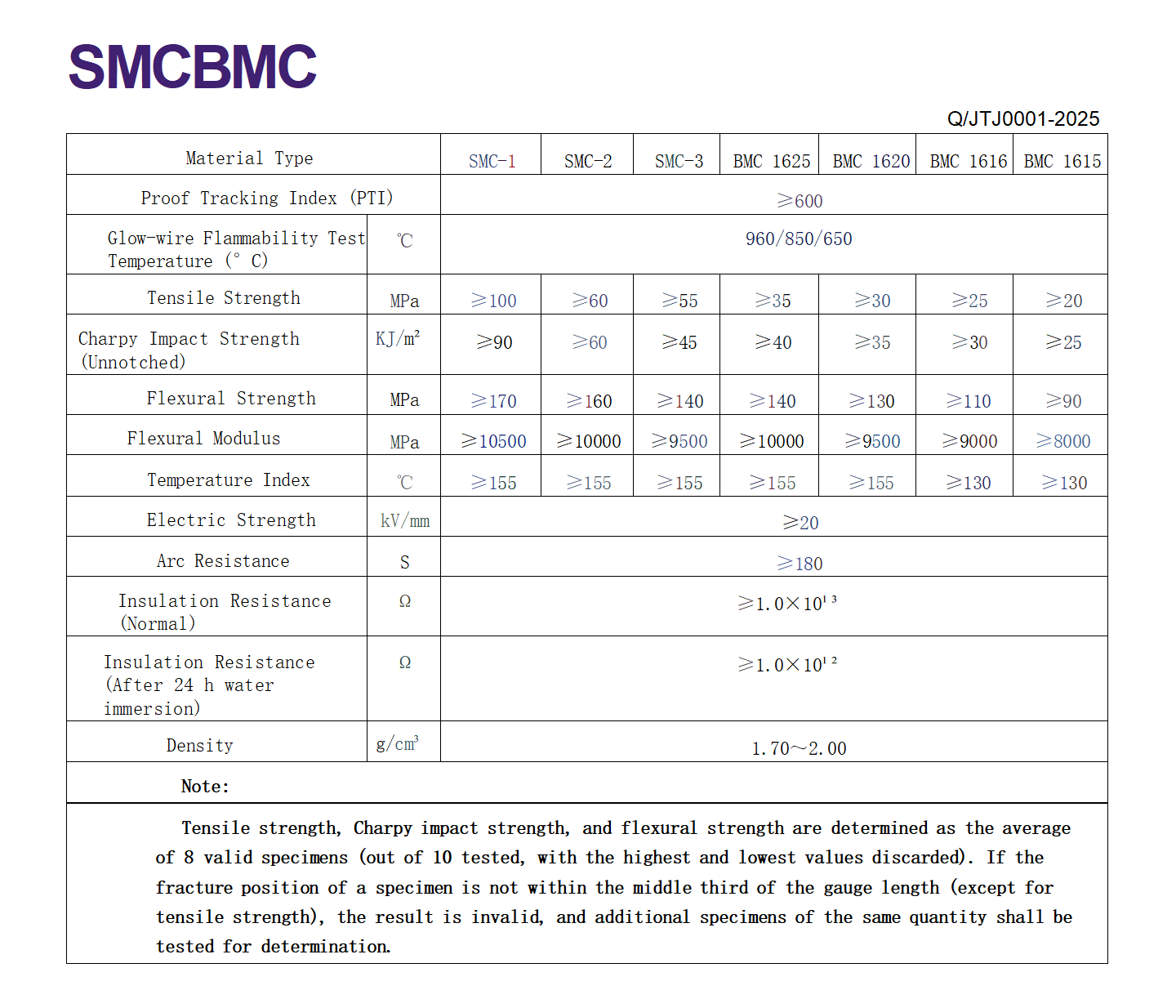
In 2025, Wenzhou Jintong published its own internal standard, Q/JTJ0001-2025, governing the technical requirements for thermoset molding compounds. This internal standard is explicitly benchmarked against GB/T 23641 — but pushes past it. Across six critical performance dimensions, the numbers speak for themselves.
1. Flexural Strength: Nearly Double the Baseline
Flexural strength dictates how much bending load a BMC part can carry before failure. For structural insulators inside circuit breakers, energy storage cabinets, or arc chutes, this is a non-negotiable design parameter.
GB/T 23641-2018: General-purpose BMC grades typically require 60–80 MPa.
Q/JTJ0001-2025: BMC 1615 ≥ 90 MPa; BMC 1620 ≥ 130 MPa; BMC 1625 ≥ 140 MPa. Among SMC grades, SMC-1 reaches ≥ 170 MPa.
The difference: a part made from Jintong's BMC 1625 or SMC-1 can carry roughly double the bending load of a commodity BMC, or carry the same load in a thinner, lighter cross-section.
2. Temperature Index (TI): Designed for Decades at Elevated Temperatures
Temperature Index — determined per IEC 60216 through accelerated thermal aging — indicates the maximum continuous-use temperature at which a material retains at least 50% of its initial flexural strength over its service life. Every 10°C increase in TI roughly doubles the expected lifetime at a given operating temperature (Arrhenius model).
GB/T 23641-2018: Common BMC grades carry a TI ≥ 130°C.
Q/JTJ0001-2025: BMC 16XX series ≥ 155°C; BMC 18XX series ≥ 170°C.
A jump from 130°C to 155°C or 170°C means a part that runs in a hot industrial enclosure or an automotive engine bay will outlast its commodity counterpart by a wide margin. This is one reason global OEMs such as Siemens and Schneider specify Jintong materials for their high-temperature applications.
3. Proof Tracking Index (PTI): Group I Across the Entire Line
PTI determines a material's material group classification under IEC 60664-1, which in turn determines the minimum creepage distance required for a given operating voltage and pollution degree. Group I (PTI ≥ 600 V) allows the shortest creepage distance — and therefore the most compact insulation design.
GB/T 23641-2018: PTI ≥ 600 V is achievable for some grades but is not a universal requirement.
Q/JTJ0001-2025: All SMC and BMC grades (SMC-1/2/3, BMC 1625/1620/1616/1615) carry PTI ≥ 600 V as a mandatory specification. Moreover, PTI is tested on every production batch — not merely during type approval.
For an engineer designing a 1500 V DC energy storage system, this means every batch of material arrives as a known Group I insulator. No derating, no extra safety margin for lot-to-lot variation.
4. Insulation Resistance — Dry and Wet
Insulation resistance governs leakage current. In outdoor or condensing environments, the wet state value is arguably more important than the dry one.
Q/JTJ0001-2025 requires dry state ≥ 1.0×10¹³ Ω and wet state (24 h immersion in distilled water at 23°C) ≥ 1.0×10¹² Ω, with the measurement completed within five minutes of removal from water to prevent drying artifacts.
Many national standards specify wet resistance requirements, but the combination of a tight post-immersion measurement window and a high 10¹² Ω threshold ensures the material truly performs in humid service — not just in the lab.
5. Dielectric Strength and Arc Resistance: Withstanding Fault Conditions
Dielectric strength: Q/JTJ0001 requires ≥ 20 kV/mm, tested in transformer oil per GB/T 1408.1 with a 2 kV/s rapid-rise method and Φ20 spherical electrodes — a test setup that eliminates surface flashover and probes the intrinsic bulk strength of the material.
Arc resistance: Q/JTJ0001 requires ≥ 180 seconds per GB/T 1411. To put that in perspective, standard engineering plastics typically survive a few seconds to a few tens of seconds under the same test. When a high-current contactor interrupts a fault, the arc can reach thousands of degrees. A 180-second rating means the insulator holds long enough for protective devices to clear the fault.
6. Flammability: Three-Tier Glow-Wire Coverage
Q/JTJ0001-2025 mandates glow-wire testing per GB/T 5169.12 at three temperature tiers: 960°C, 850°C, and 650°C. The 960°C level — the highest in the standard — simulates direct flame impingement and is a key differentiator for fire-safe applications such as battery pack insulators and railway interiors.
Raising the bar on paper is easy. Delivering it in production requires three things:
Depth in formulation R&D. BMC performance is a function of resin chemistry, filler type and loading, fiber length and content, and the cure system. Jintong operates its own materials R&D, which means formulation adjustments to meet higher targets happen in-house — not outsourced to a toll compounder.
Precision in process control. The internal process standard Q/JTJ0002-2025 mandates mold temperature uniformity ≤ ±5°C, a three-stage mold-closing speed profile, and multi-step degassing cycles. The tooling standard Q/JTJ0003-2025 specifies cavity accuracy of ±0.02 mm, mirror polishing to Ra ≤ 0.1 µm, and core hardness ≥ HRC 58. A good formulation without disciplined processing is still a gamble.
Two decades of understanding real-world service conditions. Jintong has supplied Siemens, Schneider, ABB, Eaton, Chint, and Tengen for over 20 years. The team knows what actually happens to a BMC part after 10 years of thermal cycling, vibration, and humidity — and writes the standard around that reality, not around a single lab test.
More design headroom. When the material's baseline properties exceed the national minimum, engineers can design closer to the edge without crossing it — or keep the same geometry and sleep better at night.
Batch-to-batch confidence. Q/JTJ0001 requires PTI, density, and impact strength testing on every production lot. Flexural and tensile specimens are tested in sets of 10, with the highest and lowest values discarded before averaging — a statistical rigor that catches outliers before they reach the customer's incoming inspection.
Future-proofing. As standards evolve — 1500 V PV systems, GB 38031-2025's "no fire, no explosion for 2 hours" requirement for EV batteries, EU Battery Regulation carbon-footprint declarations — Jintong's internal specs already incorporate headroom that national standards have not yet mandated.
A national standard defines what every supplier must do. An internal standard defines what one supplier chooses to do. The gap between them, measured in bending strength, temperature index, and wet insulation resistance, is what twenty-plus years of specialization in thermoset molding compounds looks like on paper.
For technical data sheets, batch certificates, or a discussion about your specific insulation requirements, contact:
📧 wendy.qiu@smcbmc.com📞 +86-13868305300