
Date | 2026-03-11 07:42:38
When engineers design electrical systems, attention is usually focused on circuits, conductors, and electronic components. These elements define how electricity flows and how the system performs.
However, behind every electrical system lies a set of components that quietly support the entire structure — insulation and structural materials.
These materials rarely receive the same attention as electrical components, yet they play a crucial role in maintaining safety, reliability, and mechanical integrity over the lifetime of the equipment.
In modern electrical equipment, composite materials such as BMC (Bulk Molding Compound) are increasingly used not only as insulation but also as structural elements within the system.
Traditionally, insulation components were viewed as passive elements whose main function was simply to separate conductive parts.
But in modern electrical equipment, many insulation components are also responsible for mechanical support and structural stability.
Examples include:
Motor terminal boards
Busbar supports
Switchgear insulation frames
Smart meter internal structures
Electrical enclosure components
These parts must maintain precise positioning of electrical conductors while also supporting mechanical loads and environmental stress.
As a result, the materials used for these components must provide both electrical insulation and structural reliability.
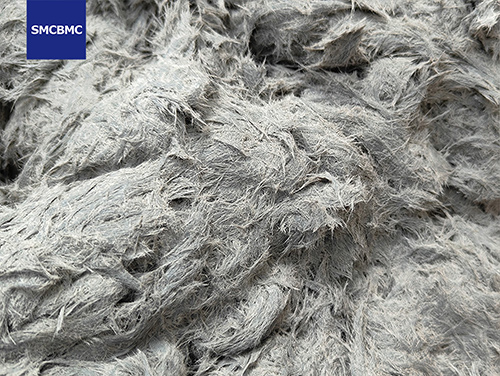
Composite materials combine different elements — such as resins, glass fibers, and mineral fillers — to achieve a balance of electrical, mechanical, and thermal performance.
Thermoset composites like BMC are particularly well suited for electrical applications because they offer multiple performance advantages in a single material.
These materials provide:
High dielectric strength for reliable insulation
Excellent dimensional stability under heat
Strong mechanical stiffness and strength
Flame retardant performance (UL94 V-0)
Resistance to moisture and environmental aging
This combination allows a single molded component to perform both electrical and structural functions within the system.
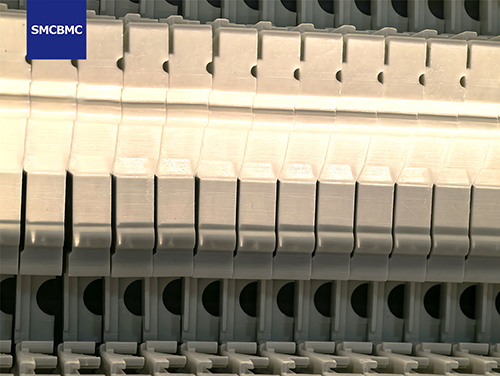
In electrical equipment, structural components are responsible for maintaining correct alignment and spacing between conductive parts.
Even small dimensional changes can affect system performance. If a material deforms or creeps over time, it may lead to:
reduced creepage and clearance distances
loosened electrical connections
increased contact resistance
vibration-related wear
potential electrical faults
This is why materials with strong long-term dimensional stability are essential for electrical component design.
Thermoset composites maintain their structure after curing and do not soften when reheated, helping ensure that critical electrical geometries remain stable throughout the product lifecycle.
Another advantage of composite materials is the ability to produce complex structures through compression molding.
Unlike traditional metal fabrication, composite molding allows multiple functions to be integrated into a single component.
For example, one molded BMC part can combine:
insulation barriers
mounting structures
mechanical supports
cable routing features
This integrated design reduces the number of separate parts and simplifies assembly while improving overall structural reliability.
As electrical systems continue to evolve toward higher power density, compact designs, and longer service life expectations, materials must play a more active role in engineering solutions.
Composite materials are no longer used only for insulation — they are becoming structural elements that support the performance and reliability of modern electrical equipment.
By combining electrical insulation with mechanical stability, composite materials help engineers design systems that are safer, more efficient, and more durable.
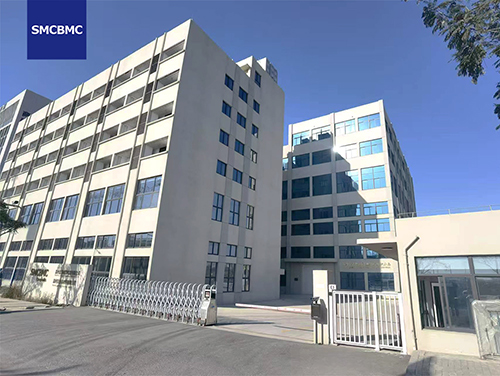
Wenzhou Jintong Complete Appliances Co., Ltd. specializes in BMC and SMC thermoset composite materials, precision mold design, and compression molding of electrical insulation components.
Our solutions are widely used in electrical equipment, smart energy systems, motors, rail transit, and industrial applications where reliable insulation and structural stability are essential.
Through integrated capabilities in material formulation, mold engineering, and manufacturing, we support customers in developing high-performance composite components for demanding electrical environments.