

Date | 2026-03-16 07:41:19
In modern electrical equipment, performance is often judged by visible specifications such as insulation strength, flame resistance, or mechanical load capacity.
However, many long-term reliability issues originate from something far less obvious — dimensional accuracy.
In electrical systems where multiple components must fit together precisely, even small deviations in part geometry can lead to assembly difficulties, electrical performance risks, and reduced service life.
For composite materials such as BMC (Bulk Molding Compound), maintaining consistent dimensional accuracy is a key factor in delivering reliable electrical components.
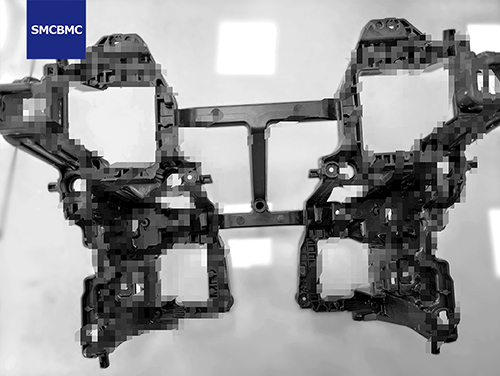
Electrical systems rely heavily on tightly controlled spatial relationships between components.
In parts such as:
motor terminal boards
smart meter housings
busbar supports
insulation spacers
switchgear structural parts
precise geometry is essential to ensure proper assembly and safe electrical operation.
When dimensional deviations occur, they may lead to issues such as:
misalignment during assembly
inconsistent mechanical preload
reduced creepage and clearance distances
increased contact resistance
compromised sealing or environmental protection
In many cases, these problems do not appear immediately but gradually affect system reliability over time.
Unlike simple plastic components, BMC composites contain glass fibers and mineral fillers, which influence how the material flows and shrinks during molding.
Dimensional accuracy therefore depends not only on the material itself but also on the entire manufacturing system.
Key factors that influence dimensional precision include:
Proper mold design ensures balanced material flow and predictable shrinkage behavior.
This is particularly important for composite materials where fiber orientation can affect dimensional consistency.
Uniform mold temperature ensures stable curing of the thermoset material.
Temperature variation within the mold cavity can lead to uneven shrinkage and dimensional deviation.
Compression pressure and curing time determine how completely the material fills the cavity and stabilizes during cross-linking.
Optimized pressure curves help minimize internal stress and dimensional distortion.
Well-designed BMC formulations balance fiber content, resin system, and mineral fillers to control shrinkage and improve dimensional repeatability.
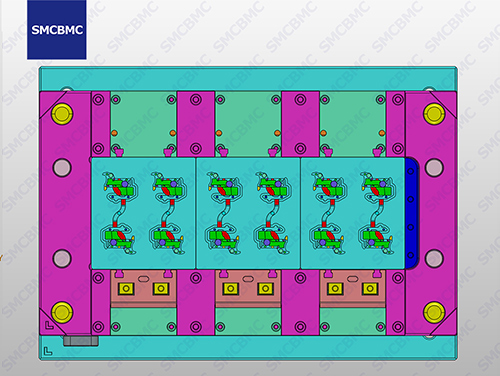
From a manufacturing perspective, dimensional accuracy has a direct impact on production efficiency and product quality.
When components maintain consistent dimensions:
assembly becomes faster and more predictable
rejection and rework rates decrease
product consistency improves across production batches
For electrical equipment manufacturers producing large volumes of assemblies, even small improvements in dimensional accuracy can significantly reduce overall production costs.
Dimensional accuracy at the time of manufacturing is only part of the challenge.
Electrical components must maintain their geometry throughout years of service under conditions such as:
temperature fluctuations
humidity exposure
vibration and mechanical stress
Thermoset composites like BMC offer advantages in this area, as their cross-linked structure resists creep and thermal deformation better than many thermoplastics.
This makes them particularly suitable for applications where long-term dimensional stability is critical.
Achieving consistent dimensional accuracy requires coordination between material formulation, mold design, and molding process control.
At Wenzhou Jintong, composite component manufacturing is developed through an integrated engineering approach that combines:
BMC material development
precision mold design
compression and injection molding capabilities
strict process control
This integrated system allows us to deliver composite components that meet the demanding dimensional requirements of electrical equipment and industrial applications.
Wenzhou Jintong Complete Electrical Co., Ltd. specializes in BMC and SMC thermoset composite materials, mold development, and precision molding of electrical components.
Our products are widely used in electrical insulation systems, motors, smart energy equipment, rail transit, and industrial infrastructure.
Through continuous engineering innovation, we provide reliable composite solutions designed for long-term performance and manufacturing consistency.