

Date | 2026-04-22 12:48:04
The safety bar for energy storage systems is rising—fast.
On April 1, 2026, China officially implemented its updated national standard for electrochemical energy storage power stations (GB/T 51048-2025), widely regarded in the industry as the most stringent design code to date. The new regulation significantly upgrades fire risk classifications for lithium-ion batteries and mandates stricter requirements for fire separation distances, fire suppression systems, and smoke control.
Additional guidelines followed within days, reinforcing a clear industry signal:
energy storage safety is no longer optional—it is foundational.
Behind these regulatory moves lies a sobering reality.
Between 2016 and 2025, more than 100 documented fire incidents occurred in electrochemical energy storage facilities worldwide. Notably:
Over 80% of incidents happened during operation and maintenance
Battery failures and system design flaws were the leading causes
In 2025 alone, more than 20 fire incidents were reported globally
Each event underscores the same challenge:
👉 thermal runaway propagation
Thermal runaway begins with a single cell—but rarely stays contained.
A localized internal failure (short circuit, overcharge, or mechanical damage) can trigger a rapid temperature rise, leading to a cascading reaction across adjacent cells, modules, and eventually the entire battery pack.
The key engineering question is simple—but critical:
How do you stop the chain reaction?
The answer often lies not in the battery chemistry—but in the materials surrounding it.
Bulk Molding Compound (BMC), a fiber-reinforced thermoset composite, is increasingly used as a structural and insulation material inside battery systems.
Its role is not active—but it is essential.
BMC components are strategically positioned along three critical thermal propagation paths:
When one cell fails, heat spreads directly to neighboring cells through structural supports and separators.
Conventional thermoplastics soften at 300–400°C
BMC maintains structural integrity and does not melt or drip
At extreme temperatures, it forms a carbonized insulating barrier
👉 Effect: slows down or blocks thermal propagation between cells
Battery packs rely on connectors, busbars, and insulation pads to carry high current.
Under thermal stress, insulation failure can trigger secondary short circuits, escalating the event.
BMC provides:
Volume resistivity > 10¹² Ω·cm
High CTI (up to ≥600V)
Stable insulation performance under heat and humidity
👉 Effect: maintains electrical isolation even under extreme conditions
When internal failure occurs, the enclosure must contain the event.
BMC housings:
Do not melt through under flame exposure
Maintain structural stability
Help prevent fire spread to adjacent modules or external systems
👉 Effect: buys critical response time for fire suppression systems
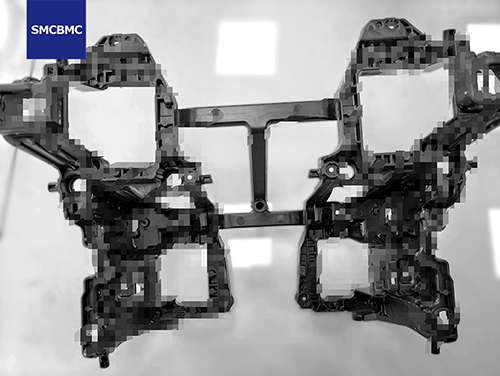
BMC is already used across multiple safety-critical components:
Cell spacers & module supports
Busbar insulation and connector structures
Battery pack housings and covers
Cable isolation and protection panels
These components operate under:
High temperature
Mechanical vibration
Electrical stress
BMC’s crosslinked structure ensures:
Minimal creep over time
Consistent dimensional stability
Long-term insulation reliability
Beyond safety, BMC also supports system-level optimization:
~60% lighter than steel
Enables integrated part design
Reduces assembly interfaces (fewer failure points)
This combination of lightweight + functional integration + fire resistance makes it particularly valuable in next-generation battery architectures.
Material properties alone are not enough.
To fully realize BMC’s safety advantages, success depends on:
Formulation design
Mold engineering
Process control
At Wenzhou Jintong Complete Appliances Co., Ltd., we integrate all three:
BMC 16XX series: flame-retardant grades (UL94 V-0 at 0.4 mm)
BMC 18XX series: high-temperature grades (continuous use ≥170°C, up to 230°C)
Custom solutions: high CTI, anti-static, low shrinkage
In a thermal runaway event, safety is measured in seconds.
Every delay in flame propagation provides critical time for detection, containment, and suppression.
BMC does not eliminate risk—but it slows it down, contains it, and makes systems more resilient.
In modern energy storage design, that makes it not just a material choice—
but a first line of defense.
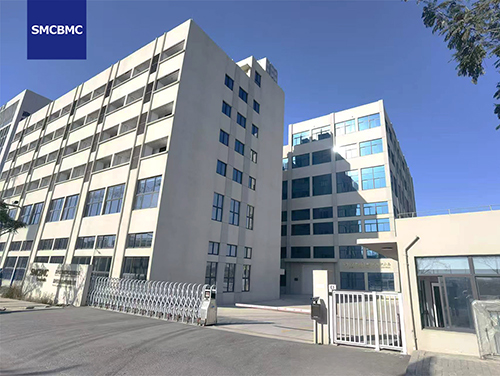
Wenzhou Jintong Complete Appliances Co., Ltd.
Specializing in BMC/SMC thermoset composites, precision molds, and compression molding.
We deliver integrated, high-reliability solutions for:
Energy storage systems
Electric vehicles
Electrical equipment
📧 wendy.qiu@smcbmc.com
📞 +8613868305300