

Date | 2026-06-04 07:47:13
In electric vehicles, PTC (Positive Temperature Coefficient) heaters are critical for cabin heating and battery thermal management. The brackets supporting these heaters must withstand a challenging combination of high temperatures, electrical loads, and mechanical vibration over the vehicle’s lifetime.
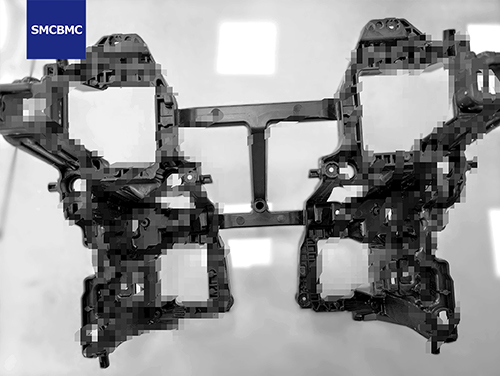
Traditionally, PA66, PBT, and PPS high-temperature engineering plastics have been used for PTC heater brackets. While these materials offer decent short-term heat resistance, their long-term performance often falls short:
PA66-GF: Prone to thermal oxidation, moisture absorption, and gradual strength loss under continuous high-temperature conditions.
PBT-GF: Lower thermal deformation threshold and faster brittle failure under prolonged heat.
PPS: Excellent thermal resistance but high cost and limited flow for complex structures.
Relying solely on heat deflection temperature (HDT) often overestimates the component’s long-term durability.
Bulk Molding Compound (BMC) is a thermosetting composite reinforced with short glass fibers (10–30%), mineral fillers, and a specialized resin system. Once cured, BMC forms a stable, cross-linked network that:
Sustains continuous operation at ≥170°C, with short-term peaks up to 230°C.
Maintains high dimensional accuracy, low thermal expansion (20–30×10⁻⁶/K), and negligible creep.
Ensures electrical safety, with insulation ≥20 kV/mm and UL94 V-0 flame retardancy.
Supports complex molding, including embedded metal inserts and reinforcement ribs, via compression or injection molding.
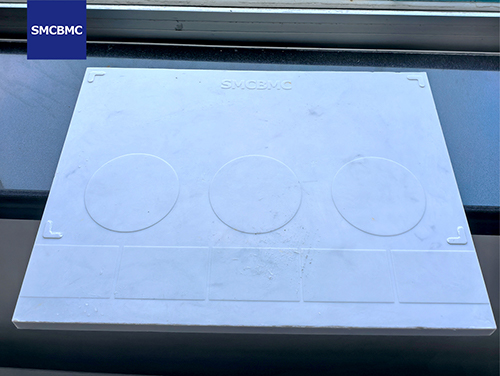
| Factor | PA66/PBT | BMC 18XX Series | Recommendation |
|---|---|---|---|
| Long-term heat resistance | Gradual degradation at 180°C | Stable at 170°C, peak 230°C | BMC preferred, verify operating temps |
| Dimensional stability | Moisture expansion, thermal creep | Thermoset, low expansion | BMC advantage |
| Electrical insulation | Degrades with moisture | ≥1.0×10¹² Ω | BMC advantage |
| Molding cycle | Fast injection | Longer compression molding | Plan multi-cavity molds for throughput |
| Material cost | PA66 price volatile, PPS high | BMC relatively stable | BMC competitive in lifecycle cost |
Selecting BMC provides engineers with a material that delivers both performance reliability and lifecycle consistency — critical for PTC heater brackets exposed to extreme EV operating conditions.
The transition from PA66/PBT to BMC is driven by engineering requirements, not just cost. For PTC heater brackets in electric vehicles, BMC offers superior thermal stability, dimensional accuracy, electrical insulation, and flame retardancy — ensuring long-term performance.
For more information about BMC materials and solutions for EV components, contact Wenzhou Jintong:
📧 wendy.qiu@smcbmc.com
📞 +86 13868305300