
Date | 2026-06-22 07:55:48
In engineering design, BMC and SMC materials are often selected for their electrical insulation and mechanical strength. However, one critical aspect is frequently underestimated: where does the heat go?
Whether it is Joule heating in circuit breaker housings, copper losses in motor windings, or heat dissipation in power electronics, inadequate thermal management can quickly lead to temperature buildup, reduced reliability, and shortened service life.
From a heat transfer perspective, BMC/SMC components play a dual role:
They act as both thermal barriers and potential thermal bottlenecks.
Heat transfer occurs through three mechanisms:
Conduction
Convection
Radiation
For solid insulation materials such as BMC and SMC, thermal conduction dominates.
The key parameter is thermal conductivity (k), defined as the ability of a material to transfer heat under a temperature gradient.
Typical values illustrate the wide material gap:
Silver: ~429 W/(m·K)
Copper: ~398 W/(m·K)
Aluminum: ~237 W/(m·K)
Water: ~0.6 W/(m·K)
Air: ~0.03 W/(m·K)
Polymers: ~0.1–0.3 W/(m·K)
The low thermal conductivity of polymers is mainly due to:
weak intermolecular (van der Waals) interactions
short phonon mean free path
strong scattering in amorphous structures
Another important parameter is thermal diffusivity, which describes how quickly a material reaches thermal equilibrium. Unlike conductivity alone, it better represents transient thermal behavior in real applications.
BMC and SMC are thermoset composites based on polyester or epoxy resins reinforced with glass fibers.
Both constituents have inherently low thermal conductivity, resulting in:
Typical BMC/SMC thermal conductivity: 0.2–0.6 W/(m·K)
This is close to water and far below metals.
Low thermal conductivity makes BMC/SMC excellent heat-blocking materials:
Battery pack fire barriers
Thermal isolation layers
Appliance housings preventing heat transfer
In these applications, thermal resistance is a functional benefit.
In power electronics, motors, and high-current systems:
heat cannot be efficiently removed
temperature rise accumulates internally
risk of thermal deformation increases
From a thermal engineering perspective, BMC/SMC is both:
an insulator electrically — and a limiter thermally.
As power density increases in modern electronics, thermal performance has become a limiting design factor.
To address this, BMC/SMC systems can be engineered with thermally conductive fillers while maintaining electrical insulation.
Aluminum Oxide (Al₂O₃)
~30–40 W/(m·K), cost-effective, electrically insulating
Boron Nitride (BN)
In-plane conductivity up to 250–300 W/(m·K), excellent dielectric stability
Silicon Carbide (SiC)
High thermal conductivity for specialized applications
These fillers form continuous heat conduction networks within the polymer matrix.
In optimized systems:
thermal conductivity can reach ~0.9 W/(m·K) (epoxy-based composites)
modified BMC systems can reach up to ~5.0 W/(m·K) while maintaining structural stiffness
Such materials are already used in:
automotive generator potting systems
motor stator encapsulation
high-power electronic insulation components
This enables designs that reduce or even eliminate traditional metal housings in certain applications.
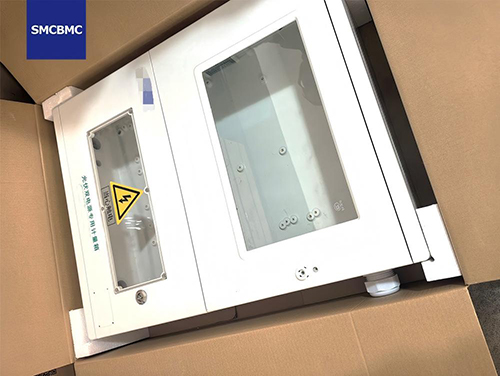
Depending on formulation, BMC/SMC can serve three distinct engineering roles:
Used in:
battery pack insulation
fire protection systems
household appliance housings
Function: prevent heat propagation
Used in:
power modules
motor stator encapsulation
electronic cooling structures
Function: enable heat dissipation while maintaining insulation
Used in:
low-voltage enclosures
switchgear components
Function: combined with structural design features (ribs, ventilation paths) to achieve adequate thermal control
| Thermal Requirement | Material Strategy | Key Parameters | Typical Applications |
|---|---|---|---|
| Thermal insulation | Standard BMC/SMC | 0.2–0.3 W/(m·K), UL94 V-0 | Battery isolation, fire barriers |
| Heat + insulation | Filled high-thermal BMC | ≥1.0 W/(m·K), high resistivity | Power modules, motor encapsulation |
| Moderate thermal load | Standard + structural cooling | 0.3–0.6 W/(m·K) | Electrical housings |
| High thermal load | Hybrid systems + heat spreaders | ≥3.0 W/(m·K) | High-power contactors, IGBT bases |
From a heat transfer perspective, BMC/SMC materials are not simply “good” or “bad” conductors.
Instead, they represent a controllable thermal design variable:
Low conductivity = thermal protection
High conductivity (engineered) = thermal management
The key is not the material itself, but the system-level thermal strategy.
Wenzhou Jintong Complete Appliances Co., Ltd. supplies:
standard BMC/SMC materials
high thermal conductivity formulations
customized composite solutions for thermal management design
Engineering support includes material selection and application-based thermal optimization.
📧 wendy.qiu@smcbmc.com
📞 +86 13868305300