

Date | 2026-06-26 07:42:17
Engineers designing multi-material assemblies often encounter a common challenge:
A component fits perfectly at room temperature—but after temperature cycling, the assembly becomes loose, misaligned, or even seized.
Whether it is a metal insert inside a circuit breaker housing, a battery module structure combining BMC insulation panels and aluminum frames, or an automotive lighting assembly exposed to thermal cycling, dimensional changes can directly affect performance, safety, and service life.
This is where BMC (Bulk Molding Compound) and SMC (Sheet Molding Compound) offer a significant advantage. Compared with conventional thermoplastics, these thermoset composites provide exceptional dimensional stability, making them ideal for precision electrical and structural applications.
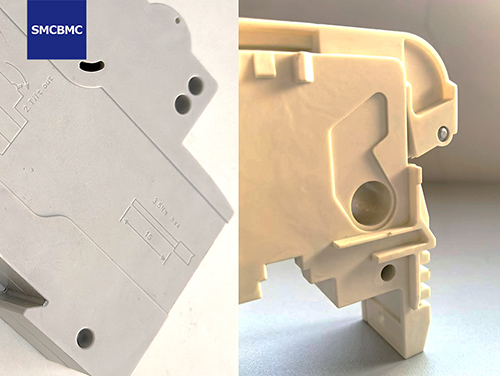
Almost all materials expand when heated and contract when cooled.
The degree of expansion is measured by the Coefficient of Linear Thermal Expansion (CLTE), which describes how much a material changes in length for each degree of temperature change.
Thermal strain can be expressed as:
ε = α × ΔT
Where:
ε = thermal strain
α = coefficient of thermal expansion
ΔT = temperature change
In assemblies combining different materials, mismatched thermal expansion rates generate internal stresses. If these stresses become excessive, they can lead to:
Loss of dimensional accuracy
Loosened assemblies
Cracking around inserts
Premature component failure
| Material | CLTE (×10⁻⁶/°C) |
|---|---|
| Steel | ~12 |
| Copper | 16–18 |
| Aluminum | ~24 |
| BMC | 13–35 |
| SMC | 12–16 |
| PA66 (unfilled) | 80–100 |
| PP (unfilled) | 100–200 |
Unlike thermoplastics, which consist of linear polymer chains that move more freely as temperature rises, thermoset composites form a highly crosslinked three-dimensional network during curing.
Additionally, glass fibers and mineral fillers possess very low thermal expansion rates themselves.
Together, these factors significantly reduce thermal movement and improve dimensional stability.
One of the most valuable characteristics of BMC and SMC is their compatibility with metal assemblies.
SMC typically exhibits a CLTE of approximately 12–16 ×10⁻⁶/°C, remarkably close to steel.
As a result, SMC components and steel structures expand and contract at nearly the same rate during temperature fluctuations, minimizing thermal stress at the interface.
This is one reason SMC is widely used in:
Electrical switchgear systems
Automotive structural components
Energy storage systems
Industrial equipment housings
Consider a 100 mm component exposed to a 50°C temperature change:
BMC expansion: approximately 0.065–0.175 mm
Unfilled PA66 expansion: approximately 0.4–0.5 mm
While the difference appears small, it can determine whether:
an electrical clearance remains compliant,
an insert remains secure,
or a precision assembly continues functioning correctly.
In electrical insulation systems, fractions of a millimeter often matter.
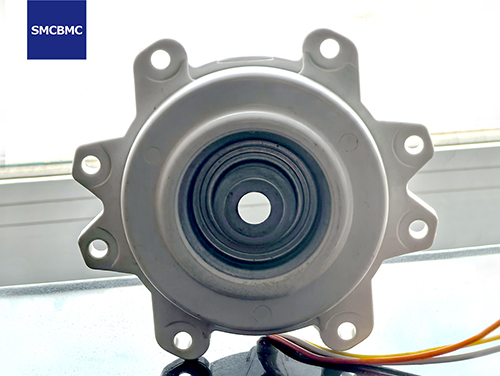
Thermal expansion affects components during service.
Shrinkage affects them during manufacturing.
Molding shrinkage occurs as the material cools and cures after processing. High-quality BMC and SMC formulations use glass reinforcement and low-shrink additives to minimize dimensional change.
Typical performance includes:
Premium SMC: ≤0.5 mm/m shrinkage
Jintong 17XX Series BMC: ≤0.2% shrinkage
This enables near-net-shape molding, reducing or eliminating secondary machining operations.
BMC and SMC are frequently combined with:
Metal inserts
Copper busbars
Aluminum frames
Structural supports
Closely matched thermal expansion minimizes stress concentrations and improves long-term reliability.
In high-voltage systems, electrical clearances and creepage distances are safety-critical dimensions.
Low thermal expansion helps maintain these dimensions across the entire operating temperature range.
Because of their low shrinkage and excellent dimensional repeatability, BMC and SMC components can often be molded directly to final dimensions without costly secondary machining.
Temperature is only part of the equation.
Moisture absorption can also influence dimensions. For outdoor or high-humidity applications, designers should consider appropriate tolerances or select low-moisture-absorption formulations.
| Application Requirement | Recommended Solution |
| Precision assemblies with metal components | SMC or low-shrink BMC 17XX Series |
| High-temperature environments | BMC 18XX Series (TI ≥170°C) |
| Outdoor electrical equipment | Weather-resistant, low-moisture formulations |
| Insert molding applications | Low-shrink BMC 17XX Series |
| Critical insulation dimensions | Materials with low CLTE and proven stability |
The key principle is simple:
Select materials not only for their strength and insulation properties, but also for how they behave dimensionally throughout their entire service life.
Dimensional stability is not merely a marketing claim—it is a measurable engineering property.
With thermal expansion coefficients as low as:
BMC: 13–35 ×10⁻⁶/°C
SMC: 12–16 ×10⁻⁶/°C
and shrinkage rates as low as:
≤0.5 mm/m for premium SMC
≤0.2% for Jintong 17XX Series BMC
these materials provide the dimensional precision required in modern electrical, automotive, and energy applications.
Understanding thermal expansion allows engineers to predict how components will behave throughout their operating temperature range—before assembly issues become field failures.
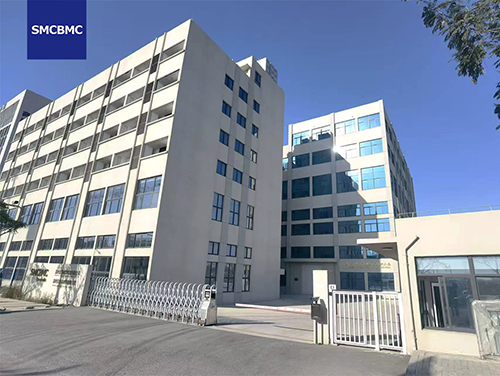
As a qualified supplier supporting projects within the supply chains of leading electrical manufacturers including Siemens, ABB, and CHINT, Wenzhou Jintong has extensive experience providing BMC and SMC solutions for precision electrical insulation and structural applications.
We provide complete dimensional-performance data, including:
Coefficient of thermal expansion (CLTE)
Molding shrinkage
Thermal aging behavior
Material selection support
to help engineers optimize precision-fit designs and long-term reliability.
📧 wendy.qiu@smcbmc.com
📞 +86 13868305300