
Date | 2026-06-29 11:35:18
In high-voltage electrical design, engineers often face a counterintuitive problem:
Even when the material has sufficient dielectric strength and the insulation thickness meets design requirements, electrical breakdown or surface tracking can still occur.
In many cases, the root cause is not material inadequacy—but non-uniform electric field distribution.
Sharp edges, conductor interfaces, air gaps, and geometric discontinuities can significantly amplify local electric field intensity. When the local field exceeds the dielectric strength of the material, insulation failure occurs.
This is why BMC (Bulk Molding Compound) and SMC (Sheet Molding Compound) are widely used in electrical insulation systems—not only for their intrinsic dielectric performance, but also for their ability to support optimized field distribution through structural design.
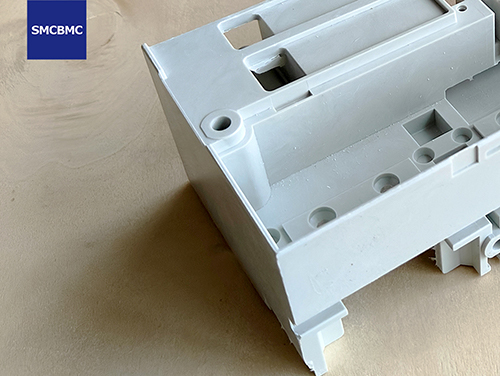
Electric field strength (kV/mm) describes how voltage is distributed within an insulating system.
In real structures, the electric field is never uniform:
It concentrates at sharp edges
It intensifies near electrode boundaries
It increases across air gaps and surface contamination zones
This phenomenon is known as electric field stress concentration.
When local electric field strength exceeds the dielectric strength of the material, electrical breakdown occurs.
This explains why identical materials can show drastically different breakdown voltages depending on geometry and design.
Dielectric constant (εr) influences how voltage is distributed between materials. In multi-layer systems, materials with lower dielectric constant tend to experience higher electric field stress.
Dielectric loss (tan δ) represents energy dissipation under AC voltage. Higher loss leads to heat generation and accelerates thermal aging in long-term operation.
BMC and SMC are thermoset composites reinforced with glass fibers and mineral fillers, providing a combination of structural stability and electrical insulation.
Typical performance levels include:
Dielectric strength: ≥18–20 kV/mm
Volume resistivity: 10¹²–10¹⁴ Ω·cm (BMC)
Surface tracking resistance (CTI/PTI): ≥600 V (Group I material)
Dielectric constant (1 MHz): ≤4.5
Dielectric loss (1 MHz): ≤0.02
For engineering design, this means:
A 2 mm thick BMC insulation wall can theoretically withstand more than 40 kV under ideal conditions, providing significant safety margin for low-voltage and medium-voltage systems.
In high-voltage insulation design, two geometric parameters dominate safety performance:
The shortest distance through air between two conductive parts.
Failure occurs when air becomes ionized and forms an arc.
The shortest distance along the surface of an insulating material.
Failure occurs when contamination or moisture forms a conductive path across the surface.
According to IEC-based classification:
Group I: CTI ≥ 600 V
Group II: 400–600 V
Group III: < 400 V
BMC/SMC materials with PTI ≥ 600 V belong to Group I.
This provides a key engineering advantage:
For the same voltage and pollution level, Group I materials require shorter creepage distances or provide higher safety margins at the same geometry.
This enables more compact and reliable electrical designs.
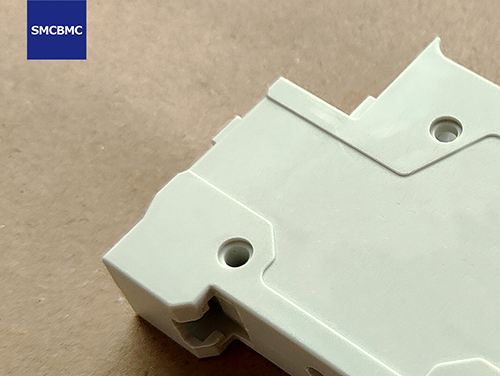
High electric field stress typically occurs at:
sharp corners
conductor edges
voids or gaps
Engineering solutions include:
smooth radius transitions (R ≥ 0.5 mm typical design rule)
optimized electrode geometry
field grading structures
Proper geometric design can significantly reduce peak field intensity even without changing material properties.
Voids, delamination, and inclusions inside molded parts act as localized field amplifiers.
This is why process control is critical:
multi-stage venting
optimized compression molding pressure profiles
controlled curing sequences
Reducing internal defects ensures consistent dielectric performance.
Humidity reduces surface resistance and dielectric strength.
High-quality BMC/SMC systems are designed to maintain:
insulation resistance ≥ 10¹² Ω after water immersion testing
For outdoor or high-humidity environments, design margins must account for moisture-induced degradation.
In composite insulation systems (e.g., BMC housing + air gaps + metal inserts), each layer redistributes electric field stress depending on dielectric constant differences.
Proper dielectric coordination ensures no single layer exceeds its breakdown limit.
| Application | Key Requirements | Recommended Material | Design Focus |
|---|---|---|---|
| High-voltage switchgear (≤35 kV) | ≥20 kV/mm dielectric strength, PTI ≥600 V | SMC insulation panels | Clearance & creepage compliance |
| Circuit breaker arc chambers | Arc resistance ≥180 s | BMC 16XX series | Electrode geometry optimization |
| 1500V energy storage systems | High insulation resistance, humidity stability | BMC 16XX / 17XX | Moisture and creepage margin |
| High-frequency insulation structures | Low dielectric constant ≤4.5 | Low-loss SMC | Minimize dielectric heating |
High-voltage insulation performance is not determined by material selection alone.
It is governed by a combined system of:
electric field distribution
material dielectric properties
geometric design
environmental conditions
manufacturing quality
BMC and SMC materials provide a strong foundation with:
dielectric strength ≥ 20 kV/mm
volume resistivity ≥ 10¹³ Ω·cm
PTI ≥ 600 V (Group I classification)
However, true reliability is achieved only when material science and field engineering are integrated into a unified design approach.
BMC and SMC insulation systems supplied by Wenzhou Jintong Complete Appliances Co., Ltd. have been widely applied in:
low-voltage and medium-voltage switchgear
energy storage insulation systems
circuit protection devices
industrial power distribution equipment
The materials are developed and validated in alignment with IEC-based insulation coordination principles and long-term field performance requirements.
📧 wendy.qiu@smcbmc.com
📞 +86 13868305300