

Date | 2026-07-23 07:45:11
Walk through an electronics cleanroom, a coal mine switchgear room, or a chemical plant's processing floor, and you'll find the same enemy: electrostatic discharge. Two insulating surfaces rubbing together can generate thousands of volts in seconds. The consequences range from fried microchips and dust-attracting housings to — in the worst case — ignition of flammable gas or combustible dust.
The traditional fix is a metal enclosure connected to ground. But as electrical equipment gets lighter, smaller, and more geometrically complex, metal imposes penalties in weight, cost, and design freedom. The question becomes: can the plastic insulator itself dissipate static charge?
That's the problem anti-static Bulk Molding Compound (BMC) and Sheet Molding Compound (SMC) were developed to solve. And in October 2025, they got their own standard.
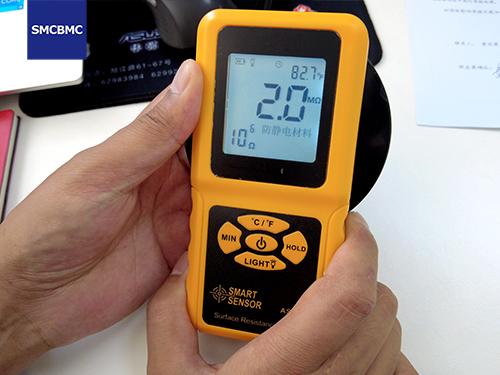
On October 10, 2025, the China Electrical Equipment Industry Association (CEEIA) published T/CEEIA 904-2025: Fiber-Reinforced Unsaturated Polyester Molding Compounds with Anti-Static Properties for Electrical Applications. This is the first dedicated product standard for anti-static BMC/SMC materials in China. It provides a unified technical framework for manufacturing, testing, and specifying these compounds.
Wenzhou Jintong and its affiliated materials subsidiary were among the industry participants that contributed to drafting this first-edition standard.
The standard's introduction frames the issue directly: thermoset polyester molding compounds are valued for their excellent insulation and moisture resistance in electrical and electronic applications. But precisely because of their high volume resistivity, "they are highly susceptible to electrostatic accumulation during production and use, leading to dust attraction, electric shock (discharge), combustion, and even explosion." The standard targets applications ranging from military equipment to coal mining — environments where static isn't just a nuisance, it's a safety hazard.
T/CEEIA 904-2025 classifies anti-static BMC/SMC into three grades based on surface resistivity, measured per GB/T 31838.3 at 100 V DC with a 1-minute electrification time:
| Grade | Surface Resistivity (Ω) | What It Means | Typical Applications |
|---|---|---|---|
| AS-1 | < 1.0 × 10⁵ | Conductive — charge bleeds almost instantly | Sensitive electronics packaging, military explosion-proof housings, cleanroom tooling |
| AS-2 | 1.0 × 10⁵ ~ 1.0 × 10⁶ | Static-dissipative — rapid charge decay | Mining equipment enclosures, chemical valves, powder conveying pipes |
| AS-3 | 1.0 × 10⁶ ~ 1.0 × 10¹¹ | Anti-static — prevents hazardous accumulation | General electronic structural parts, ESD-safe trays, switchgear internal barriers |
The three grades differ not only in resistivity but also in mechanical and flammability requirements — reflecting the reality that a part's job rarely stops at "don't spark." The standard's full performance specifications are shown in Table 1 (BMC) and Table 2 (SMC).
Table 1: Anti-Static BMC Performance Requirements per T/CEEIA 904-2025
| Property | Unit | BMC-AS-1 | BMC-AS-2 | BMC-AS-3 |
|---|---|---|---|---|
| Flexural strength | MPa | ≥ 100 | ≥ 120 | ≥ 120 |
| Charpy impact (unnotched) | kJ/m² | ≥ 25 | ≥ 30 | ≥ 30 |
| Deflection temperature (Tf1.8) | ℃ | ≥ 220 | ≥ 240 | ≥ 240 |
| Surface resistivity | Ω | < 1.0×10⁵ | 1.0×10⁵~1.0×10⁶ | 1.0×10⁶~1.0×10¹¹ |
| Flammability | class | ≥ HB | ≥ HB | ≥ V-0 |
| GWFI | ℃ | ≥ 960/3.0 | ≥ 960/3.0 | ≥ 960/2.0 |
| Density | g/cm³ | 1.60~2.10 | 1.60~2.10 | 1.60~2.10 |
| Mold shrinkage | % | ≤ 0.15 | ≤ 0.15 | ≤ 0.15 |
| Water absorption | % | ≤ 0.2 | ≤ 0.2 | ≤ 0.2 |
| Temperature Index (TI) | — | ≥ 130 | ≥ 130 | ≥ 130 |
Table 2: Anti-Static SMC Performance Requirements per T/CEEIA 904-2025
| Property | Unit | SMC-AS-1 | SMC-AS-2 | SMC-AS-3 |
|---|---|---|---|---|
| Flexural strength | MPa | ≥ 160 | ≥ 170 | ≥ 170 |
| Charpy impact (unnotched) | kJ/m² | ≥ 60 | ≥ 70 | ≥ 70 |
| Deflection temperature (Tf1.8) | ℃ | ≥ 240 | ≥ 240 | ≥ 240 |
| Surface resistivity | Ω | < 1.0×10⁵ | 1.0×10⁵~1.0×10⁶ | 1.0×10⁶~1.0×10¹¹ |
| Flammability | class | ≥ HB | ≥ HB | ≥ V-0 |
| GWFI | ℃ | ≥ 960/3.0 | ≥ 960/3.0 | ≥ 960/2.0 |
| Density | g/cm³ | 1.60~2.10 | 1.60~2.10 | 1.60~2.10 |
| Mold shrinkage | % | ≤ 0.15 | ≤ 0.15 | ≤ 0.15 |
| Water absorption | % | ≤ 0.2 | ≤ 0.2 | ≤ 0.2 |
| Temperature Index (TI) | — | ≥ 130 | ≥ 130 | ≥ 130 |
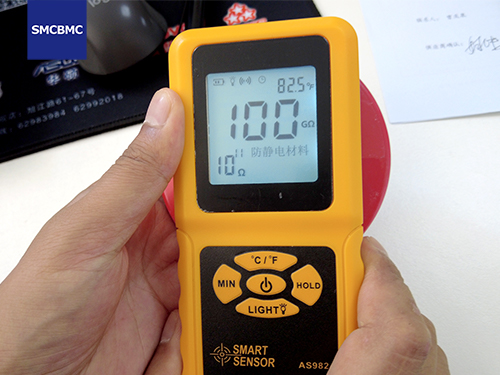
Note the pattern: AS-3 demands V-0 flammability class and 960°C/2.0 glow-wire performance — because it serves as both a static-safe barrier and a structural, fire-resistant insulator inside electrical equipment. AS-1 and AS-2 accept HB class because their primary mission is conductivity in environments where the fire safety regime may be handled differently. The standard also mandates a notably short shelf life for the more conductive grades: 15 days for AS-1 and AS-2, versus 30 days for AS-3 — a reflection of the tighter stability window of the conductive filler network in these formulations.
Standard BMC/SMC exhibits volume resistivity above 10¹³ Ω·cm — excellent for insulation, terrible for static dissipation. The engineering solution is to embed a sub-microscopic conductive network within the polymer matrix while preserving the compound's mechanical properties and moldability.
This works through percolation theory: when conductive filler particles reach a critical volume fraction (the percolation threshold), they either physically contact one another or come close enough for quantum tunneling to occur, forming a continuous pathway that drops surface resistivity by orders of magnitude.
The main filler families in industrial use:
Conductive carbon black — the workhorse. Nano-scale particles with high specific surface area form percolating networks at relatively low loading. Cost-effective and well-proven. The trade-off: carbon black is, well, black. Any compound using it will be black.
Graphite / carbon fiber — offer dual mechanical reinforcement and conductivity. Same color constraint.
Metal oxides / conductive whiskers — e.g., antimony-doped tin oxide coated onto titanium dioxide or other substrates. Enables non-black formulations, but typically at higher cost and with more formulation sensitivity.
Intrinsically conductive polymers (ICPs) — such as polyaniline (PANI) or PEDOT/PSS. These can be blended into the resin at low loading and offer color flexibility, but thermal stability during molding and long-term aging behavior remain active areas of development.
The material finds its way into a diverse set of applications where static cannot be tolerated, as summarized in Table 3.
Table 3: Typical Applications by Industry
| Industry | Typical Parts | Recommended Grade | Key Requirements |
|---|---|---|---|
| Mining / oil & gas | Explosion-proof enclosures, junction boxes, sensor housings | AS-1 / AS-2 | Low surface resistivity + flame retardancy + corrosion resistance |
| Military / aerospace | Ammunition packaging, missile launcher supports, ESD-safe pallets | AS-1 | Ultra-low resistivity + high mechanical strength |
| Semiconductor / electronics | Wafer handling trays, cleanroom tooling, static-dissipative dividers | AS-2 / AS-3 | Dimensional stability + particle-free + washable |
| Electrical power | Switchgear anti-static barriers, CT/PT insulation supports | AS-3 | V-0 flame class + bulk insulation + surface dissipation |
| Powder handling | Conveying pipe flanges, silo liners | AS-1 / AS-2 | Abrasion resistance + chemical resistance + low surface resistivity |
In underground coal mining, electrical equipment enclosures must simultaneously meet flame-retardant requirements and maintain surface resistivity low enough to prevent charge accumulation from igniting methane. A metal enclosure is heavy and corrosion-prone. A standard plastic enclosure is light but dangerously insulating. Anti-static BMC splits the difference: the low-resistivity surface of a metal, the lightweight and corrosion-resistant body of a thermoset, and the ability to mold complex, ribbed geometries in a single shot.
In semiconductor fabs, wafers sliding across plastic trays and tooling generate triboelectric charge continuously. An ESD event can punch through a gate oxide layer in nanoseconds. Anti-static BMC AS-2/AS-3 trays and fixtures allow charge to leak to ground without introducing the metallic particle contamination risk that a metal alternative would carry.
For a material specification that hinges on surface resistivity, color seems like the last thing anyone should worry about. Until it's the reason a design gets rejected.
The overwhelming majority of anti-static BMC on the market is black. The reason is straightforward: conductive carbon black remains the most cost-effective, process-stable, and mechanically benign anti-static filler available. Its percolating chain structure has been validated across decades of industrial use. But carbon black imparts an inseparable deep black color. For most applications, that's fine. For others, it's a dealbreaker.
Medical device tooling may require white or light gray for visual contamination inspection. Food processing equipment parts may require blue to comply with industry visual standards. Some OEMs simply need a non-black appearance for brand or product-line differentiation.
Achieving anti-static performance without black pigment is a genuinely hard formulation problem. Most alternative conductive fillers either deliver lower conductivity efficiency (requiring higher loading, which degrades mechanical properties), carry their own color (graphite is gray), or suffer from cost and batch-consistency challenges.
Wenzhou Jintong has addressed this through conductive filler hybridization and formulation optimization on its BMC 15XX anti-static series. The result: non-black formulations that still meet AS-3 anti-static requirements. This capability removes a persistent trade-off for designers who need both static dissipation and color flexibility — whether the requirement is white, gray, blue, or custom-matched.
T/CEEIA 904-2025 gives the industry something it didn't have before: a common language for anti-static BMC. Three clearly defined grades. Systematic performance benchmarks. Transparent test methods and inspection rules. For the engineer writing a material specification, it eliminates guesswork. For the buyer, it provides an objective basis for incoming inspection.
Wenzhou Jintong — a contributor to the standard's development — offers its BMC 15XX series covering the AS-2 and AS-3 grades, with surface resistivity in the 10⁶–10⁹ Ω range. Custom formulations for AS-1 requirements are available on request. And for applications where color matters as much as conductivity, non-black anti-static BMC is no longer off the table.
For technical data sheets, grade recommendations, or a discussion about your specific static-control requirements:
📧 wendy.qiu@smcbmc.com📞 +86-13868305300