

Date | 2026-08-04 16:52:25
Ask most engineers where Bulk Molding Compound (BMC) belongs, and the answers will be predictable: circuit-breaker housings, energy-storage insulation barriers, automotive lamp brackets. It is a material that lives in distribution cabinets, battery packs, and engine bays — not, intuitively, in a bathroom.
Yet BMC mirror frames are already in circulation in markets around the world. Hotel bathroom mirrors, dressing-table frames, decorative mirrors in commercial spaces — a meaningful share of these everyday objects are molded from BMC. The reason is a combination of properties that turns out to be highly relevant to bathroom environments: moisture resistance, dimensional stability, and the ability to mold complex decorative shapes in a single shot.
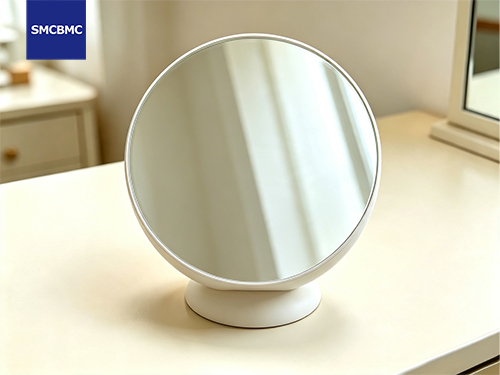
A mirror frame faces harsher service conditions than its appearance suggests.
High humidity, continuously. Bathroom frames are exposed to condensation, steam, and occasional water splashes for years. Conventional thermoplastics — PS, ABS — absorb moisture over time, warp, and can develop surface defects. Solid wood performs worse still, with swelling, cracking, and mold growth as routine failures.
Temperature cycling. The temperature difference between a cold mirror surface and hot water vapor in winter can exceed 30°C. If the frame's coefficient of thermal expansion mismatches that of the glass (approximately 9×10⁻⁶/°C), the frame distorts, the glass loosens, and edge chipping can follow.
Long service life expectations. A mirror is a durable good, designed for 5–10 years or more. The frame must hold its dimensions, color, and structural integrity through years of humidity cycling.
Point by point, BMC's material profile maps onto these requirements:
Low water absorption. BMC exhibits water absorption ≤ 0.2%, with wet-state insulation resistance ≥ 10¹² Ω after 24 hours of immersion (per Q/JTJ0001-2025). In plain terms: it does not take up water, so it does not warp or support mold growth in humid environments.
Dimensional stability. BMC's coefficient of linear thermal expansion is 13–35×10⁻⁶/°C — close to glass (~9×10⁻⁶/°C) and aluminum (~24×10⁻⁶/°C). Mold shrinkage as low as ≤ 0.2% (low-shrinkage grades) keeps the frame precisely matched to the mirror glass over time.
Design freedom. Compression molding produces curved, relief, and irregular cross-sections in one operation, with surface finishes ranging from matte and glossy to simulated wood grain and metallic effects.
Mechanical rigidity. With flexural strength from 90 to 205 MPa depending on grade, thin-wall frame structures retain adequate stiffness without heavy sections.
| Property | BMC | Solid Wood | Aluminum Alloy | PS/ABS |
|---|---|---|---|---|
| Moisture resistance | Excellent (≤ 0.2% water absorption) | Poor — swells, cracks, molds | Good, but surface finish may degrade | Fair — absorbs moisture, warps over time |
| Dimensional stability | Excellent (shrinkage ≤ 0.2%) | Poor — moves with humidity and temperature | Good | Poor — high thermal expansion |
| Design freedom | High — complex relief in one shot | Medium — complex shapes require assembly | Low — extrusion-based profiles | High |
| Batch consistency | Excellent — mold replication precision | Poor — natural wood variation | Good | Good |
| Flammability | UL94 V-0 (0.4 mm) | Combustible | Non-combustible | ~HB class |
| Long-term cost | Higher tooling investment, amortized over volume | Material cost volatile, labor-intensive | Multi-step fabrication and assembly | Low unit cost at volume |
The differentiator is clear: BMC wins on the combination of moisture resistance, dimensional stability, and design freedom. For manufacturers and specifiers who prioritize durability and visual consistency across large volumes — hotels, high-end residential projects, commercial fit-outs — that combination is compelling.
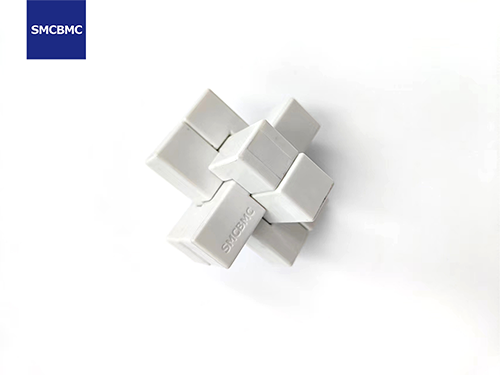
Producing a BMC mirror frame follows a well-defined process:
Grade selection. Low-shrinkage grades (shrinkage ≤ 0.2%) are preferred to ensure precise final dimensions and tight fit with the mirror glass.
Tooling. Mold cavity accuracy of ±0.02 mm and mirror-polished surfaces (Ra ≤ 0.1 µm) ensure surface finish and part consistency.
Compression molding. Mold temperature 135–170°C, three-stage closing-speed profile (30 mm/s → 5 mm/s → 15 mm/s), and multi-stage degassing (2–3 venting cycles at 70–80% fill, each ≤ 0.8 s). Cure time follows wall thickness × (1.2–1.5) min/mm.
Post-cure. Parts are post-cured at 80–100°C for 30–60 minutes to relieve residual stress, followed by flash trimming.
Assembly. The frame is bonded or clipped to the glass; the low shrinkage of BMC keeps the joint stable over years of thermal cycling.
The penetration of BMC into consumer durables is slow but steady — and mirror frames are one example among several, alongside BMC bath panels, sink surrounds, and sanitary fittings.
Three forces are driving this shift:
Durability economics. In products bought once and used for years, the lifecycle advantages of thermosets compound. Fewer warranty replacements offset the higher initial material cost.
Batch consistency. Compression molding reproduces complex designs with excellent repeatability, which brand owners value for quality control.
Compliance readiness. RoHS-compliant, low-VOC formulations give BMC a defensible basis for indoor decorative applications.
The constraints are equally real: high tooling investment favors large production runs; color development must account for functional fillers; and consumer awareness of thermoset materials remains limited. Market education is part of the work ahead.
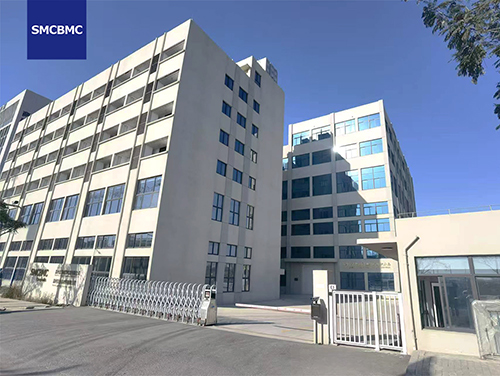
With more than two decades in BMC/SMC materials and molding, Wenzhou Jintong offers an integrated path for mirror-frame and similar consumer applications:
Custom formulations tailored to frame geometry (thin-wall vs. thick-wall, curved vs. flat) and appearance requirements (matte, gloss, simulated wood grain). Low-shrinkage series deliver precise fit with mirror glass.
In-house tooling and molding — thermoset mold design and fabrication (per Q/JTJ0003-2025) combined with full-process molding control (per Q/JTJ0002-2025) enable one-stop development from material to finished part.
Color and surface options across standard and custom shades.
Environmental compliance — materials meet RoHS 2.0 substance limits (per Q/JTJ0001-2025), suitable for indoor decorative use.
Whether you are evaluating BMC for mirror frames, bath panels, or other humid-environment applications, the material's core argument is the same: it does not take up water, it does not move, and it holds a molded shape for decades.
📧 wendy.qiu@smcbmc.com📞 +86-13868305300