
Date | 2026-08-12 07:54:06
When an overseas customer asks whether your material "has UL," they are rarely asking about the UL mark on a finished product. In most cases, they are asking about the UL Yellow Card — formally, the UL Recognized Component listing for the material itself.
A Yellow Card is not product certification. It is material certification: an independent, third-party verification that a specific molding compound meets UL's performance requirements across flammability, thermal endurance, and electrical properties. For engineers, it functions as a publicly queryable, trustworthy material data sheet — one that both supplier and customer can reference without debate.
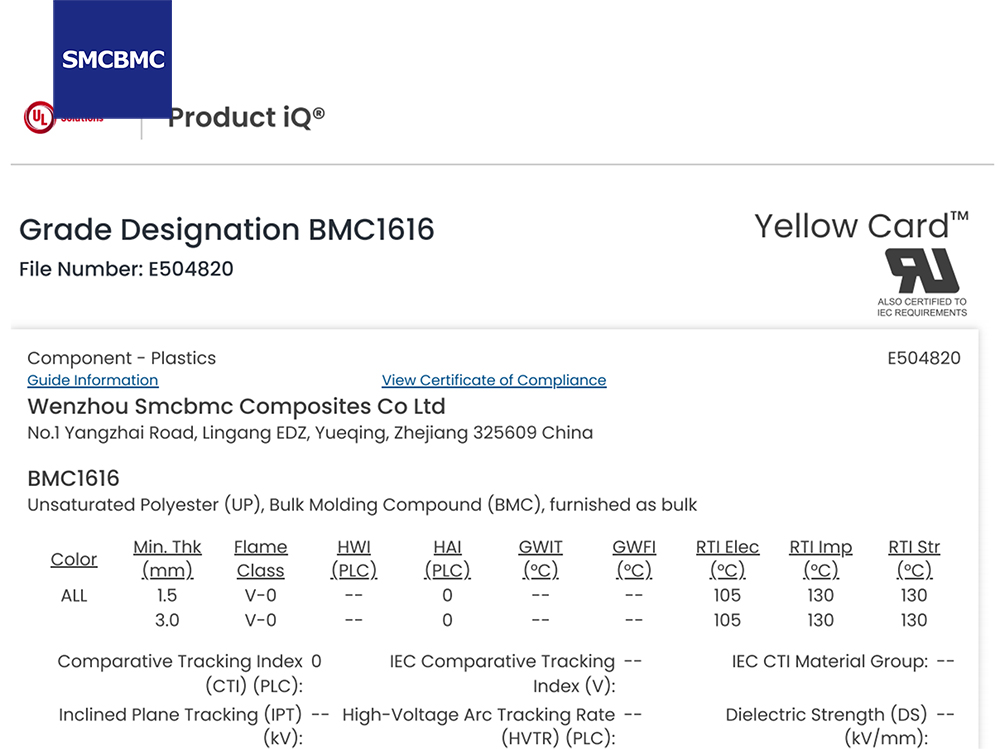
A typical UL Yellow Card lists several parameters that directly inform material selection:
Flammability rating (UL94). The most widely cited parameter. V-0 means the material self-extinguishes within 10 seconds after flame removal, with no flaming drips — a critical property for electrical enclosures and structural insulators.
Relative Thermal Index (RTI). RTI quantifies long-term heat resistance through accelerated thermal aging. It is reported separately for electrical strength and mechanical properties.
Comparative Tracking Index (CTI). CTI measures a material's resistance to electrical tracking on its surface — the parameter that drives creepage distance design in polluted environments. CTI ≥ 600 V corresponds to Material Group I: the shortest required creepage distance for a given voltage and pollution degree, enabling more compact insulation designs.
Other electrical parameters. Including High Amp Arc Ignition (HAI), dielectric strength, and volume resistivity, which together form the material's performance profile for a given application.
Market access. UL has a long-standing tradition in North American electrical applications, and buyers across Europe and Asia increasingly treat the Yellow Card as default proof of material reliability. Without it, entering North American supply chains becomes measurably harder.
Streamlined product certification. When a finished product undergoes UL certification, materials that already hold Yellow Card listings can be referenced directly, eliminating substantial retesting of internal components and shortening certification timelines.
Clear liability boundaries. A Yellow Card is backed by an independent body. In any performance dispute, the listed parameters serve as a mutually accepted technical baseline — reducing friction between supplier and customer.
Design efficiency. Engineers can pull the Yellow Card number into UL Product iQ, retrieve key parameters instantly, and screen materials for a design without waiting for paper test reports.
Step 1 — Sample testing. Test specimens are submitted to UL-recognized laboratories for UL94 flammability, thermal aging (RTI determination), and electrical tests (CTI, HAI, dielectric strength).
Step 2 — Factory inspection. UL conducts periodic follow-up inspections of the production site, confirming that the production formula, process, and quality system match the certified samples. This is the mechanism that keeps the certification valid — any formula change must be disclosed and re-evaluated.
Step 3 — Issuance and publication. Upon passing, the material receives a Yellow Card number and is published in the UL Product iQ database, publicly queryable by engineers worldwide.
Timeline and cost: Certification typically takes several months; cost scales with the number of test items and grades. It is a one-time investment with long-term returns — but it is also an ongoing commitment, because UL's follow-up inspections continue for as long as the listing remains active.
A Yellow Card is not a certificate you earn once and forget. It is a continuously supervised quality system — every formulation adjustment and every production batch falls within UL's inspection scope.
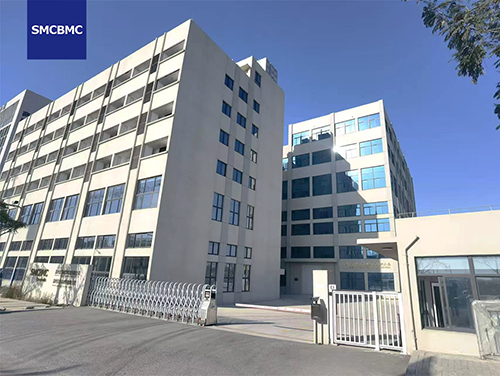
Wenzhou Jintong's BMC 1616 grade holds UL Yellow Card certification under File E504820, publicly queryable in the UL Product iQ database.
In parallel, Jintong's enterprise standard Q/JTJ0001-2025 includes key performance indicators in batch-level outgoing inspection, ensuring consistency in production quality.
The value of a UL Yellow Card is ultimately this: a verifiable, traceable, continuously supervised performance commitment. For the supplier, it is an external endorsement of the quality system. For the customer, it is a technical foundation for material selection. For the industry, it is a common language of technical trust.
Wenzhou Jintong is happy to discuss how our certified BMC grades can support your next design — whether you need the Yellow Card data for a new product submission or simply want a reliable material for a demanding application.
📧 wendy.qiu@smcbmc.com📞 +86-13868305300